MLS Campus offers all the Florida real estate courses you need — sales associate pre-license, post-license, broker, and continuing education — 100% online from a state-approved Florida real estate school. All our Florida real estate classes are self-paced, so you can study around work, family and your current job.

MLS Campus is an accredited real estate license school in Florida. We have been providing quality Florida real estate courses for over 20 years, and take pride in helping our students in working towards getting a real estate license. MLS Campus provides real estate training for Florida Real Estate Pre -Licensing, Post Licensing and Continued Education, helping students to study in their own time, at their own pace, and from the comfort of their own home. So, if you are looking to study in your spare time while working in your current job, a distance learning real estate course for Florida may be the best study option to fit your needs!

All Florida Real Estate License Schools and Florida real estate courses must be approved by the FREC (Florida Real Estate Commission). Each Florida real estate license course we provide has been FREC-approved. Our accredited Florida real estate license school, MLS Campus, is also registered with the DBPR, Department of Business and Professional Regulation. Here is our License Number (ZH1002474).

Hear From Our Real Estate Students

Sales associate pre-license

Everything you need to qualify for the Florida state exam.

Course essentials
  • Seamless mobile experience
  • Read, listen, or do both
  • Final exam + course certificate
  • Dedicated Instructor Support
  • AI Instructor 24/7
Exam prep & career
  • Exam prep master, math cram + ebook
  • Live webinars with expert tutors
  • Personal Real Estate Coaching

Starting at

$98.02

Risk-free satisfaction guarantee

Sales Associate Post License

Everything you need to qualify for the Florida state exam.

Course essentials
  • Seamless mobile experience
  • Read, listen, or do both
  • Unlimited End of Course Practice Exam
  • Final exam + course certificate
  • Dedicated Instructor Support
  • AI Instructor 24/7

Starting at

$79

Risk-free satisfaction guarantee

Broker Pre-License

Everything you need to qualify for the Florida state exam.

Course essentials
  • Seamless mobile experience
  • Read, listen, or do both
  • Final exam + course certificate
  • Dedicated Instructor Support
  • AI Instructor 24/7
Exam prep & career
  • Exam prep master, math cram + ebook
  • Live webinars with expert tutors
  • Personal Real Estate Coaching

Starting at

$115.42

Risk-free satisfaction guarantee

Broker Post-License

Everything you need to qualify for the Florida state exam.

Course essentials
  • Seamless mobile experience
  • Read, listen, or do both
  • Unlimited End of Course Practice Exam
  • Final exam + course certificate
  • Dedicated Instructor Support
  • AI Instructor 24/7

Starting at

$149

Risk-free satisfaction guarantee

Continuing Education

Everything you need to qualify for the Florida state exam.

Course essentials
  • Seamless mobile experience
  • Read, listen, or do both
  • Unlimited End of Course Practice Exam
  • Final exam + course certificate
  • Dedicated Instructor Support
  • AI Instructor 24/7

Starting at

$34.22

Risk-free satisfaction guarantee

REACTIVATION

Everything you need to qualify for the Florida state exam.

Course essentials
  • Seamless mobile experience
  • Read, listen, or do both
  • Unlimited End of Course Practice Exam
  • Final exam + course certificate
  • Dedicated Instructor Support
  • AI Instructor 24/7

Starting at

$79

Risk-free satisfaction guarantee

Florida Real Estate Salesperson State Exam Preps

Everything you need to qualify for the Florida state exam.

Course essentials
  • Seamless mobile experience
  • Read, listen, or do both
  • Dedicated Instructor Support
  • AI Instructor 24/7
  • Course Review
Exam prep & career
  • Unlimited interactive quizzes
  • Full-Length Practice Exams
  • Math-Focused Practice Exams
  • Exam Prep Ebook

Starting at

$79

Risk-free satisfaction guarantee

Florida Real Estate Broker State Exam Preps

Everything you need to qualify for the Florida state exam.

Course essentials
  • Seamless mobile experience
  • Read, listen, or do both
  • Dedicated Instructor Support
  • AI Instructor 24/7
  • Course Review
Exam prep & career
  • Unlimited interactive quizzes
  • Full-Length Practice Exams
  • Math-Focused Practice Exams
  • Exam Prep Ebook

Starting at

$149

Risk-free satisfaction guarantee

Questions & Answers

Florida Real Estate Courses – Frequently Asked Questions

How do I get a Florida real estate license?
To become a licensed Florida real estate sales associate you must complete the 63-hour FREC-approved pre-license course, pass the Florida state licensing exam, and submit your application to the DBPR. MLS Campus delivers all 63 hours 100% online.
How much do Florida real estate courses cost at MLS Campus?
The 63-hour Florida sales associate pre-license packages start at $98.02, with higher tiers adding instructor support, full audio and exam prep. Packages are currently discounted up to 50% and include a 30-day money-back guarantee.
How long does it take to get a Florida real estate license?
Most students complete the 63 hours of pre-license education in 3 to 8 weeks. Because MLS Campus courses are self-paced and fully online, you can finish as quickly as you like and then schedule the state exam.
Is MLS Campus approved by FREC?
Yes. MLS Campus is a FREC-approved Florida real estate school, DBPR provider license number ZH1002474. You can verify our approval with the Florida DBPR.
What is the difference between a Florida sales associate and broker license?
A sales associate completes the 63-hour pre-license course and works under a licensed broker. A Florida broker license requires the 72-hour broker pre-license course plus at least 24 months of active real estate experience. MLS Campus offers both.
Can I complete the Florida real estate courses online?
Yes. Every MLS Campus Florida course is 100% online and self-paced. You can read, listen to the full audio, or watch, with expert instructor support and free practice exams included.
Do you offer a guarantee?
Yes. MLS Campus backs its Florida courses with a pass-or-refund promise and a 30-day money-back guarantee, so you can enroll risk-free.

What Is The Best Way To Get a Real Estate License In Florida?

The best way to get your real estate license in Florida is to first complete and pass an approved Florida real estate course.
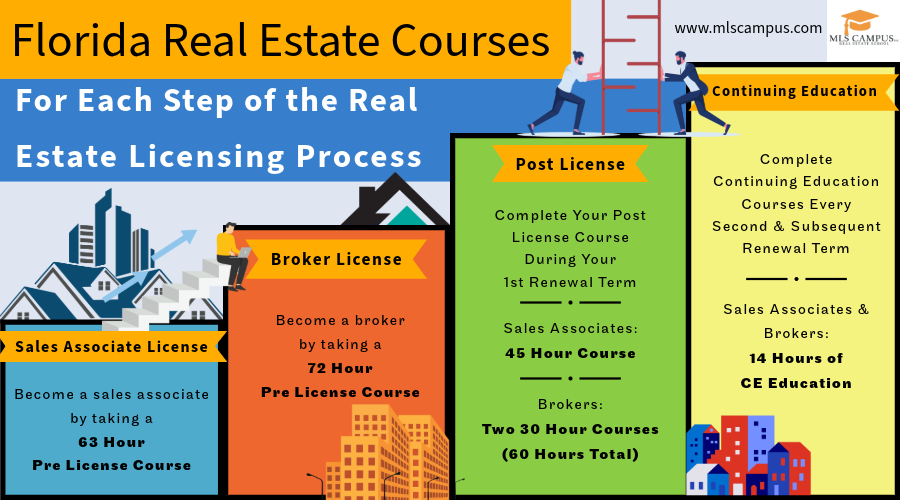
Florida Real Estate Courses for Each Step of the Licensing Process

To become a real estate agent, you must complete the Florida Pre License real estate course for sales associates, pass your Florida State exam and meet the licensing requirements for real estate agents.

Our real estate license course for sales associates is designed so that you can study in your own time and pace, allowing you to fit your studies around your busy schedule. We aim to provide you with the best way to get your real estate license so that you can achieve your goals and become a real estate agent. To view our great promotions on our Florida real estate courses, follow the link to our Florida Pre License Real Estate Course for Sales Associates.

If you need more information on the best way to get your real estate license in Florida and the licensing requirements for real estate agents follow the link to our blog – How to Get Florida Real Estate License or watch our video guide on YouTube.

If you have your Florida real estate sales associate license and are looking to upgrade to an associate broker license or a real estate broker license, you must first meet the state requirements and complete the pre license course for associate broker license and broker license.

Start your online broker course today and get great discounts by following the link – 72hr Pre License Course for Broker

The state requirements for a Florida associate broker license and broker license are explained in more detail in the following article; How to Become a Real Estate Broker in Florida

You can also watch our short video on YouTube

Florida Non Resident Real Estate License Requirements

If you are a real estate licensee, resident out of Florida State, and are looking for the best way to get your real estate license in Florida, please check the Florida mutual recognition information below. If you are looking to get a non resident Florida real estate license and you are resident in a state where there is no mutual recognition, you must follow the same real estate licensing process as a Florida resident.

If you are resident in a state in which Florida has a Mutual Recognition Agreement with, you may request a Florida sales associate license, an associate broker license or a Florida broker real estate license under mutual recognition. Mutual Recognition States with Florida real estate are: Alabama, Arkansas, Connecticut, Georgia, Illinois, Mississippi, Nebraska and Rhode Island.

If you are not resident in one of the Mutual Recognition States with Florida real estate, you can either apply for your real estate sales associate license and take the Pre License Florida real estate license course for sales associates, or you can use your two years experience within the past five years in your current state as a sales associate. If you have a broker license, you may apply for a Florida broker’s license, or an associate broker license. You would be required to take the Pre License Florida real estate course for broker and associate brokers license and pass the full 100 question state exam. For more information on our broker's real estate course, please follow the link to our 72hr Pre License Course.

At MLS Campus we aim to provide you with the best quality Florida real estate courses at affordable prices to help you get your license. You can start your Florida real estate license course and get instant access to your online learning portal in just a few clicks!

Licensing Renewal Requirements for Real Estate Agents, Associate Brokers & Brokers

For real estate agents who have their license, MLS Campus provides Florida real estate courses for each step of the license renewal process. The Florida Real Estate Sales Associate license and Florida Real Estate Broker, and Associate Broker license must be renewed every two years. Please check the information below, to learn more about the licensing requirements for real estate agents, associate brokers & brokers if it is time for your license renewal.

Are you a Sales Associate Looking to Renew Your License Online?

A Florida real estate sales associate license must be renewed every 2 years, from the date the license was issued, or from the last renewal date. Renewal applications and fees must be submitted to the DBPR.

If you are a sales associate looking to renew your license online during your first initial renewal term, you must complete the 45-Hour Post-License Course, and pass the final exam to meet the licensing requirements for real estate agents. Students are permitted two attempts at passing the 45-Hour Post-License Course exam. If you fail the final exam the second time, you will need to retake the course.

MLS Campus School will offer you the retake for free as long as your course is still active.

If you are looking to renew your license online for the first time, please follow the link to view our great offers and start your course now - Post License 45-Hour Post-License Course

Are You a Broker or Associate Broker Looking to Renew Your License Online?

A Florida Real Estate Broker License must also be renewed every 2 years. Applications for a broker license renewal must be made to the DBPR, along with payment of the renewal fee.

To complete your broker license renewal, you must meet the real estate broker education requirements which are to take two 30 Hour Broker Post License Courses for Florida and pass the final exams. If you fail the final exam the second time, you will need to retake the course.

MLS Campus Florida Real Estate License School will offer you the retake for free as long as your Florida real estate course is still active.

If you want to meet your real estate broker education requirements and renew your real estate license online and in time, please follow the link to our Broker Post License Courses and get instant access to your online learning portal!

For further information on how to renew your real estate license in Florida, please read the following article; How to Renew Your Real Estate License in Florida

You can also watch our video guide on YouTube.

If you have already renewed your license for the first time, and you are looking to renew your real estate license online for the second renewal term or more, all real estate agents, brokers and associate brokers must take the Florida Real Estate Continuing Education Course.

Florida Real Estate License Second Renewal and Up

After completing the initial Florida real estate 45 Hour post license course, or the 60 Hour broker post license course Florida, students are required to renew their licenses, thereafter by completing the Florida Real Estate Continuing Education Course.

Why Choose to Study with MLS Campus - Florida Real Estate School?

Whether you are just starting out in your Florida real estate career, or you are looking to take the next step in getting your broker license for Florida, MLS Campus is a Florida Real Estate School that provides a full range of accredited Florida real estate courses, post-licensing real estate courses, and Florida real estate continuing education courses. We will also provide you with all the information you will need to know, in order to pass your Florida real estate state exam. MLS Campus will support you every step of the way in getting your Florida real estate license!

With courses that fit your schedule, learn at your own pace, on your PC, Mac, Tablet, and Smartphone, from the comfort of your own home. We are here to support you, throughout every step of your Florida real estate license course. Chat with our friendly support team. We are also available over weekends!


Florida License Renewal • 2026 Edition

How to Renew Your Florida Real Estate License

A clear, step-by-step guide to your Florida real estate license renewal through the DBPR — the 2-year cycle, the 45-hour sales associate and 60-hour broker post-license education for your first renewal, the 14-hour continuing education requirement after that, fees, deadlines, and how to renew online.

First Renewal
45 / 60 hrs
Post-License Education
45 hrs sales associate · 60 hrs broker
then
Every Renewal After
14 hrs
Continuing Education
3 Core Law · 3 Ethics · 8 specialty
2-year renewal cycle · expires March 31 or September 30 · renew online at the DBPR
Start Here

Your Florida Real Estate License Renewal at a Glance

Florida real estate licenses are renewed every two years through the Department of Business and Professional Regulation (DBPR). What you need to do depends on whether this is your first renewal or a later one — here is exactly how it works.

This guide reflects current Florida Real Estate Commission (FREC) and DBPR renewal rules.

Florida License Renewal Requirements
Renew every 2 years by your March 31 or September 30 deadline
First renewal: complete post-license education (45 hours sales associate / 60 hours broker)
Every renewal after: complete 14 hours of FREC-approved continuing education
Pay the renewal fee and submit your renewal to the DBPR
Renew online at MyFloridaLicense.com before the deadline
DBPR Process

How to Renew Your Florida Real Estate License

Follow these four steps to complete your DBPR license renewal and keep your license active.

1

Confirm Your Renewal Date & Status

Look up your license on the DBPR portal at MyFloridaLicense.com to confirm your expiration date (March 31 or September 30) and whether it is your first or a subsequent renewal.

2

Complete Your Required Education

For your first renewal, complete the 45-hour sales associate (or 60-hour broker) post-license course. For every renewal after that, complete 14 hours of FREC-approved continuing education. Finish before your deadline — the provider reports your hours to the DBPR.

3

Renew Online & Pay the DBPR Fee

Log in to MyFloridaLicense.com, submit your renewal, and pay the renewal fee by credit card (or mail a check). You can renew up to 90 days before your expiration date.

4

Confirm “Active” Status & Keep Records

After renewing, verify your license shows as “active” on MyFloridaLicense.com and keep your course certificates for your records in case of a DBPR audit.

Education Requirements

Florida Real Estate Renewal Education Requirements

What you must complete depends on your license type and whether it is your first renewal or a later one.

First Renewal: 45-Hour Sales Associate Post-License

If you hold a sales associate license, your very first renewal requires a FREC-approved 45-hour post-license course — not the 14-hour CE. It builds on your pre-license education with the practical skills new agents need, covering listings, contracts, financing, and running your business. You must complete it before your first expiration date; if you do not, your license becomes null and void and you would have to start the licensing process over.

First Renewal: 60-Hour Broker Post-License

If you hold a broker license, your first renewal requires a FREC-approved 60-hour post-license course instead of the 14-hour CE. It covers brokerage operations, management, and compliance. Like the sales associate post-license, it must be finished before your first expiration date — an incomplete broker post-license requirement also makes the license null and void.

Every Renewal After: The 14-Hour Continuing Education Requirement

Once your post-license education is complete, every Florida real estate license renewal after that requires 14 hours of FREC-approved continuing education in each two-year cycle, broken down as follows:

3 hours Core Law · 3 hours Ethics & Business Practices · 8 hours Specialty Education

You can complete all 14 hours online at your own pace. Note: a Florida Bar member in active, good standing is exempt from the 14-hour continuing education requirement.

Renew on Time with the 14-Hour CE Course
FREC-approved Core Law, Ethics & Business Practices, and specialty hours — 100% online, completed at your own pace.
Enroll in the 14-Hour CE →
What It Costs

Florida Real Estate License Renewal Fees

Cost ItemFeeNotes
Sales Associate Renewal Fee$64Active status, paid to the DBPR
Broker Renewal Fee$72Active status, paid to the DBPR
14-Hour CE CourseOnlineFREC-approved, completed at your own pace
Late Renewal FeeVariesAssessed for renewing after the deadline

Fees approximate as of 2026 — verify your current renewal fee and any late fee with the DBPR before renewing.

Renew Your Florida Real Estate License Online
Complete your Florida continuing education self-paced and 100% online, with full audio and instructor support.
Start Your Florida CE — from $34.22
Beat the Deadline

Renew Your Florida License On Time

Whether it is your first renewal or a later one, MLS Campus has the FREC-approved course you need — 100% online, self-paced, with your hours reported to the DBPR. Choose the course that fits your renewal:

45-Hour Post-License
Sales associates — required before your first renewal.
Get 45-Hr Post-License →
60-Hour Post-License
Brokers — required before your first renewal.
Get 60-Hr Post-License →
14-Hour Continuing Education
Every renewal after your first.
Get 14-Hr CE →
✓ FREC-Approved School  ·  ✓ 20+ Years Experience  ·  ✓ Hours Reported to the DBPR
Deadlines

When Is Your Florida License Renewal Due?

Your renewal date is set by the DBPR based on when you were first licensed. Here is the timeline:

Expiration
March 31 or September 30 — whichever date falls about two years after your license was issued.
First cycle
Your first renewal falls 18–24 months after licensure and requires post-license education.
Up to 90 days early
You can renew up to 90 days before your expiration date once your education is complete.
Cutoff
Education and fee are due by midnight EST on the expiration date (extended to the next business day if it lands on a weekend or holiday).
Pro Tip: Confirm your exact renewal date on MyFloridaLicense.com — do not rely on memory, as the date is tied to your original licensure date, not the calendar year.
If You Miss It

Missed Your Renewal? Inactive, Reactivation & Null and Void

If you do not meet your renewal requirements by the deadline, your license becomes involuntarily inactive — you cannot legally practice real estate until you reactivate it.

Within 2 years: reactivate by completing the 28-hour reactivation course and paying the required fees. After 2 years inactive: your license becomes null and void and you must re-qualify from the beginning.

The simplest path is to renew on time. If your license is already inactive, our 28-hour Florida license reactivation course gets you back to active status.

Why It Matters

Why Renew Your Florida License On Time?

Florida real estate agent planning a long-term career after renewing their license
Keep Earning
Stay active and avoid a break in your commissions
$94,562
Avg. Licensed Agent Salary — FL (ZipRecruiter, 2026)
No
State Income Tax in Florida
100,000+
Students Trained by MLS Campus

Renewing on time keeps your license active, protects your income, and saves you from having to re-license. A few hours of online CE every two years is all it takes to keep your Florida real estate career moving.

Salary data: ZipRecruiter (2026), with career outlook from the U.S. Bureau of Labor Statistics. Individual results vary.

Renew Smart

Tips for a Stress-Free Florida License Renewal

A little planning keeps your renewal simple and your license active. These tips help you stay ahead of the deadline.

Licensed agent completing Florida real estate continuing education online to renew
📅 Know Your Exact Date
Check MyFloridaLicense.com for your March 31 or September 30 deadline and set a reminder 90 days out.
💻 Do Your CE Online
Complete all 14 hours online at your own pace; your provider reports your hours straight to the DBPR.
⏱️ Don’t Wait for the Last Minute
Finish early to avoid a late fee or, worse, slipping into involuntarily inactive status.
🧾 Keep Your Certificates
Save your CE completion certificates in case the DBPR audits your renewal.
✅ Verify “Active” After Renewing
Once you submit, confirm your status shows “active” on MyFloridaLicense.com so you can keep practicing without interruption.
First Renewal Only

Get Your Florida Post-License Course Online

Both the 45-hour sales associate and 60-hour broker post-license courses are available 100% online with MLS Campus. Finish before your first renewal deadline to keep your license active and avoid going null and void.

Newly Licensed? Complete Your 45-Hour Post-License Course
Required before your first renewal — finish the 45-hour (sales associate) or 60-hour (broker) post-license online with MLS Campus.
Get Post-License →
Got Questions?

Frequently Asked Questions

How often do you renew a Florida real estate license?

Every two years. Your license expires on March 31 or September 30, whichever date falls about two years after you were first licensed.

How many CE hours do I need to renew my Florida real estate license?

14 hours of FREC-approved continuing education each cycle: 3 hours Core Law, 3 hours Ethics & Business Practices, and 8 hours specialty. Your first renewal instead requires 45 hours (sales associate) or 60 hours (broker) of post-license education.

How much does it cost to renew a Florida real estate license?

The DBPR renewal fee is about $64 for sales associates and $72 for brokers, plus the cost of your CE course. A late fee applies after the deadline. Always verify current fees with the DBPR.

How do I renew my Florida real estate license?

Complete your required education, then log in to the DBPR portal at MyFloridaLicense.com, submit your renewal, and pay the fee. You can renew online up to 90 days before your expiration date.

What happens if I do not renew on time?

Your license becomes involuntarily inactive and you cannot practice. You can reactivate within two years by completing a 28-hour reactivation course and paying the fees. After two years inactive, the license is null and void and you must re-qualify.

Are Florida Bar members exempt from continuing education?

Yes. A member of The Florida Bar in active, good standing is exempt from the 14-hour continuing education requirement, but must still renew and pay the fee.

Can I renew my Florida real estate license online?

Yes. Renewals are completed online through the DBPR’s MyFloridaLicense.com portal, where you can also pay the renewal fee and confirm your active status.

In Short

Key Takeaways

🔄 Renew Every 2 Years
By March 31 or September 30, set by your original licensure date.
📚 14-Hour CE
3 Core Law + 3 Ethics & Business + 8 specialty hours.
🎓 First Renewal = Post-License
45 hours (sales associate) or 60 hours (broker).
💳 DBPR Fee
~$64 sales associate / ~$72 broker, paid online.
💻 Renew Online
Through the DBPR portal at MyFloridaLicense.com.
⚠️ Miss It → Inactive
Reactivate within 2 years; after that, null and void.
Renew Today

Renew Your Florida Real Estate License Today

MLS Campus is a FREC-approved school with over 20 years of experience. Complete the renewal course you need — 45-hour post-license, 60-hour broker post-license, or your 14-hour continuing education — 100% online, at your own pace.

Ready to Renew? Get Your Florida CE Done
Finish your Florida continuing education online and self-paced, with audio and expert support — before your deadline.
Start Your Florida CE — from $34.22

Florida Real Estate Broker Guide • 2026 Edition

How to Become a Real Estate Broker in Florida

The complete, step-by-step guide to upgrading your sales associate license to a Florida broker license — from the 72-hour FREC-approved broker course and DBPR application to the Pearson VUE state exam.

Start the 72-Hour Florida Broker Pre-License Course →

Comparing states? See our national guide: How to Become a Real Estate Broker — experience, course hours, and the exam by state.
72
Pre-License Hours
24 mo
Experience Required
100
State Exam Questions
$91.75
DBPR Application Fee
Get Started

Become a Real Estate Broker in Florida

You have built experience as a licensed sales associate — now you are ready to branch out, open your own brokerage, and supervise other agents. Becoming a Florida broker is the next step, and this guide shows you exactly how to become a real estate broker in Florida.

This guide reflects current requirements from the Florida Real Estate Commission (FREC) and the Department of Business and Professional Regulation (DBPR).

Florida Real Estate Broker License Requirements
Hold an active real estate sales associate license
Complete 24 months of active experience within the past 5 years
Finish your required sales associate post-license education
Complete a 72-hour FREC-approved broker pre-license course
Pass a background check (electronic fingerprints)
FREC-Approved Process

5 Steps to Become a Real Estate Broker in Florida

You must first complete 24 months as an active sales associate within the past five years. Once you meet that requirement, follow these five steps to earn your Florida real estate broker license.

1

Complete Your 72-Hour Broker Pre-License Course

Enroll in and complete a FREC-approved 72-hour broker pre-license course covering real estate appraising, investment, financing, brokerage, and management operations. MLS Campus offers this course fully online. Pass the end-of-course exam (70%) to receive your certificate.

2

Apply for Your Broker License With the DBPR

Submit the Florida broker license application (Form RE-2 — upgrade from sales associate to broker) to the DBPR with the $91.75 fee. You can apply online or by mail. Online applications are typically processed in 10–30 days.

3

Submit Your Electronic Fingerprints

Submit electronic fingerprints through a DBPR-approved Livescan service provider for your background check. Your prints must be on file before the DBPR can approve your application.

4

Pass the Florida Broker State Exam

Once the DBPR approves your application, schedule your Pearson VUE broker state exam (100 questions, 75% to pass). It covers brokerage management, finance, investment, appraising, real estate law, and math.

5

Activate Your Florida Broker License

After you pass the state exam, submit the DBPR RE-13 Broker Transaction form to activate your Florida real estate broker license. You can then open your own brokerage or operate as a broker associate.

The State Exam

Understanding the Florida Real Estate Broker Exam

The Florida broker state exam is administered by Pearson VUE and consists of 100 multiple-choice questions. You need a score of 75% (75/100) to pass. It covers real estate law, brokerage management, finance, investment analysis, appraising, and real estate math.

Exam fee: $36.75 per attempt · Format: 100 questions · Pass mark: 75%

Review the current Pearson VUE Candidate Information Booklet for brokers for identification and admission requirements before your scheduled exam.

Pass the Florida Broker Exam on Your First Try
Full-length practice exams and targeted review with the Florida Broker State Exam Prep Master.
Get Exam Prep — $149 →
What to Budget

Complete Cost Breakdown: Florida Real Estate Broker License

Cost ItemFeeNotes
72-Hour Broker Pre-License CourseFrom $115Varies by package and format
DBPR Application Fee (RE-2)$91.75Paid to the Florida DBPR
State Exam Fee$36.75Paid to Pearson VUE per attempt
Fingerprinting~$50–80Varies by Livescan vendor
Estimated Total~$290–320Plus optional exam prep

Fees approximate as of 2026 — verify current amounts with the Florida DBPR and Pearson VUE before applying.

Ready to Advance?

Advance Your Career as a Florida Broker

Enroll in the FREC-approved 72-hour broker pre-license course — 100% online and self-paced. Everything you need to pass the Florida broker state exam and run your own brokerage.

✓ FREC-Approved School  ·  ✓ 20+ Years Experience  ·  ✓ 100% Online & Self-Paced
Enroll in the 72-Hour Broker Course →
Courses from $115 · Instant online access
Timeline

How Long Does It Take to Become a Broker?

Once you have met the 24-month experience requirement, most candidates complete the broker licensing process in 1 to 3 months. Here is a realistic breakdown:

Weeks 1–4
Complete the 72-hour broker pre-license course — as fast as 3 weeks full-time, 4–6 weeks part-time.
Weeks 2–6
Submit your DBPR (RE-2) application & fingerprints — online processing is typically 10–30 days (up to 90 by law).
Weeks 5–8
Schedule and pass the Pearson VUE broker exam — test soon after finishing your course while the material is fresh.
Weeks 6–9
Activate your broker license (Form RE-13) and open your brokerage or work as a broker associate.
Pro Tip: MLS Campus online coursework lets you study evenings and weekends without stepping away from your active real estate business.
Out-of-State Agents

Florida Real Estate Broker License Reciprocity

Florida has mutual recognition with 10 states. If you hold an active license in one of these states, you can apply for the equivalent Florida license without retaking the full pre-license course:

AlabamaArkansasConnecticutGeorgiaIllinoisKentuckyMississippiNebraskaRhode IslandWest Virginia

To qualify under mutual recognition you must hold an active license in good standing, not be a Florida resident at the time of application, and pass the 40-question Florida Law exam at Pearson VUE. Brokers from states without a mutual recognition agreement must complete the 72-hour broker pre-license course and pass the full Florida broker exam.

Why Become a Broker

Why Become a Real Estate Broker in Florida?

Florida real estate broker meeting with clients
$99,416
Avg. Broker Salary — FL (Indeed, 2026)
Own a Firm
Run your own brokerage and hire sales associates
No
State Income Tax in Florida
100,000+
Students Trained by MLS Campus

A broker license lets you work independently, open your own real estate firm, and earn a share of every sales associate’s commission. Combined with Florida’s population growth, year-round demand, and no state income tax, it is one of the strongest career moves in real estate.

Salary data: Indeed (2026) and the U.S. Bureau of Labor Statistics. Individual results vary with experience, market, and effort.

Study Smart

Tips for Passing the Florida Broker Exam

Candidates who complete the 72-hour broker course and prepare with practice exams pass on their first attempt. These tips help you study efficiently and walk in confident.

Studying online for the Florida real estate broker exam
📅 Set a Study Schedule
Treat the 72-hour course like a job — block regular study time each week. Online coursework lets you study around your existing real estate work.
🧩 Focus on Broker-Level Topics
The broker exam goes deeper than the sales associate exam. Give extra time to brokerage management, real estate finance, investment analysis, appraising, and math.
📝 Use Practice Exams
Rehearse with full-length practice exams. The Florida Broker State Exam Prep Master and Math Cram target the areas brokers find hardest.
⏱️ Know the Exam Logistics
The Pearson VUE broker exam is 100 questions, 75% to pass, $36.75 per attempt. Schedule it soon after finishing your course while the material is fresh.
💻 Learn at Your Own Pace
Study online and fit your broker coursework around clients and closings, then test when you are consistently scoring above 75%.
After You Get Licensed

Broker Post-License Education & Renewal

Before your first broker license renewal, you must complete a 60-hour broker post-license education course. If it is not completed in time, your broker license reverts to active sales associate status. After your first renewal, brokers complete 14 hours of continuing education every two years to keep the license active.

Newly Licensed Broker? Complete Your 60-Hour Post-License Course
Florida requires 60 hours of broker post-license education before your first renewal — finish it online with MLS Campus.
Get Broker Post-License →
Got Questions?

Frequently Asked Questions

How long do you have to be an agent before becoming a broker in Florida?

You must complete 24 months of work as an active real estate sales associate within the past five years before you can apply for a Florida broker license.

What are the requirements for a Florida real estate broker license?

The Florida real estate broker license requirements are: hold an active sales associate license, complete 24 months of active experience within the past 5 years, finish your sales associate post-license education, complete a 72-hour FREC-approved broker course, pass the broker state exam (75%), and clear a fingerprint background check.

What is the difference between a real estate agent and a broker?

A sales associate works under the supervision of a licensed broker. A broker has passed the broker exam, can own a real estate firm, and can hire and supervise sales associates.

How much does it cost to get a Florida real estate broker license?

Expect roughly $290–$320 total: a DBPR application fee of $91.75, a state exam fee of $36.75, fingerprinting around $50–$80, plus a 72-hour broker course starting from $115.

Can I apply for my Florida broker license online?

Yes. The RE-2 upgrade-to-broker application is submitted online through the Florida DBPR, with a mail-in PDF option also available.

Does Florida have broker license reciprocity?

Florida has mutual recognition with 10 states. Qualifying out-of-state licensees take the 40-question Florida Law exam instead of the full state exam.

How long does it take to become a broker in Florida?

After meeting the 24-month experience requirement, most candidates finish the course, application, and exam in 1–3 months, depending on study pace and DBPR processing times.

In Short

Key Takeaways

🎓 72 Hours Required
Complete a FREC-approved 72-hour broker pre-license course before the state exam.
🧭 24 Months Experience
Work as an active sales associate for 24 months within the past 5 years.
✅ Pass Both Exams
70% on the course final, 75% on the Florida broker state exam.
📒 $91.75 Application
Submit the RE-2 upgrade application to the Florida DBPR.
🏢 Run Your Own Firm
A broker can open a brokerage and hire sales associates.
🚀 60-Hour Post-License
Required before your first broker license renewal.
Get Started Today

Start Your Florida Broker Career Today

MLS Campus is a FREC-approved school with over 20 years of experience helping students pass the Florida real estate broker exam. Complete your 72-hour broker course online, at your own pace.

‹ Part of our national guide: How to Become a Real Estate Broker

FLORIDA REAL ESTATE LICENSING · 2026 GUIDE

Florida Real Estate License Reciprocity in 2026

Who Can Skip the 63-Hour Course — and Who Cannot

10Mutual Recognition States
40Question FL Law Exam
75%Minimum Pass Score
4–8 WksTypical Processing Time
WHAT YOU NEED TO KNOW

Florida Uses Mutual Recognition, Not Traditional Reciprocity

If you already hold a real estate license in another state and you are eyeing Florida’s booming market, you may not need to sit through 63 hours of pre-licensing coursework. Florida’s Department of Business and Professional Regulation (DBPR) has established Mutual Recognition Agreements with 10 specific states — a streamlined pathway that lets qualifying out-of-state agents skip the standard pre-licensing education requirement entirely.

But this shortcut is not available to everyone. Even agents who do qualify still face a mandatory hurdle: a 40-question Florida-specific real estate law exam administered through Pearson VUE. Understanding exactly who qualifies — and under what conditions — can save you months of coursework and hundreds of dollars.

This guide covers the 10 qualifying states, the non-negotiable eligibility rules, the step-by-step application process, and what to do when your home state is not on the list.

QUICK FACTS

✓  Skip the 63-hour pre-license course
✓  Must be a non-Florida resident
✓  License must be active & in good standing
✓  Earned by original education, not reciprocity
✓  Pass 40-question FL law exam at 75%+
✓  Affiliate with a Florida broker to activate
FREC MUTUAL RECOGNITION

The 10 States With Mutual Recognition Agreements

Licensed agents from these states can apply without completing the 63-hour pre-licensing course.

ALAlabama
ARArkansas
CTConnecticut
GAGeorgia
ILIllinois
MSMississippi
NENebraska
OKOklahoma
RIRhode Island
WVWest Virginia
ELIGIBILITY RULES

Who Qualifies: The Non-Negotiable Rules

1

Non-Florida Resident at Time of Application

You must not be a Florida resident when you apply. Florida residents are ineligible for mutual recognition.

2

Active License from a Partner State

Your out-of-state license must be current, valid, and in good standing. Inactive or expired licenses do not qualify.

3

License Earned Through Original Education & Exam

You must have earned your license through full education and examination requirements — not via your state’s own reciprocity process.

4

Age & Education Minimums

Must be at least 18 years old and hold a high school diploma or equivalent.

APPLICATION PROCESS

How to Apply: 6 Steps to a Florida License

Step 1

Verify Your State Qualifies

Confirm your home state is on the FREC mutual recognition list. As of 2026: Alabama, Arkansas, Connecticut, Georgia, Illinois, Mississippi, Nebraska, Oklahoma, Rhode Island, and West Virginia.

Step 2

Request Certified License History

Contact your home state real estate commission for an official certified license history proving your license is active, in good standing, and earned through original education and exam requirements.

Step 3

Submit Your DBPR Application

Complete the Florida sales associate or broker application at MyFloridaLicense.com. Include your certified license history and the applicable application fee.

Step 4

Schedule the Florida Law Exam

After DBPR approval, schedule your 40-question Florida law exam through Pearson VUE. It tests Florida-specific statutes, license law, and regulations.

Step 5

Pass With 75% or Higher

You need at least 30 of 40 correct. Topics include Florida license law, FREC rules, agency relationships, and Florida-specific transaction requirements.

Step 6

Affiliate with a Florida Broker

Once you pass, affiliate with an actively licensed Florida broker to activate your license. You cannot practice real estate in Florida as an unaffiliated sales associate.

Your State Does Not Qualify? There Is Still a Fast Path.

MLS Campus delivers the FREC-approved 63-hour Florida pre-license course 100% online. Start today and get licensed in as little as 10 weeks.

DISQUALIFIERS

Who Cannot Use Mutual Recognition — and What to Do Instead

Most licensed agents in the U.S. will not qualify because their home states are not on Florida’s list. Major states absent from mutual recognition include Texas, California, New York, North Carolina, Tennessee, Pennsylvania, and Michigan.

Mutual recognition is off the table if:

Your home state is not one of the 10 mutual recognition states
You are already a Florida resident at time of application
Your out-of-state license is expired, inactive, or suspended
You obtained your license through that state’s own reciprocity process

The path forward: Complete the FREC-approved 63-hour pre-licensing course, pass the full Florida exam, and affiliate with a licensed broker. Exception: agents licensed elsewhere for 2 of the past 5 years may waive the broker pre-licensing course but still need the Florida broker exam.

RENEWAL REQUIREMENTS

After You Get Licensed: Florida Renewal Requirements

Mutual recognition gets you licensed — but Florida renewal obligations apply to every licensee equally.

45 hrs

Sales Associate Post-License

Before your first renewal, complete a FREC-approved 45-hour post-licensing course covering advanced Florida brokerage practices.

60 hrs

Broker Post-License Education

Brokers must complete a 60-hour post-licensing course before their first renewal covering brokerage management and operations.

14 hrs

CE Every Two Years

After your first renewal, 14 hours of continuing education every two years keeps your Florida license active and in good standing.

GOT QUESTIONS?

Frequently Asked Questions

Not in the traditional sense. Florida uses a Mutual Recognition system rather than full reciprocity. Qualifying agents can bypass the 63-hour pre-licensing course but must still pass a 40-question Florida real estate law exam. Full reciprocity with zero additional requirements is not offered by Florida.
Most U.S. states do not have mutual recognition with Florida. Notably absent are Texas, California, New York, North Carolina, Tennessee, Pennsylvania, Michigan, Ohio, New Jersey, and Colorado. Agents from these states must complete the full 63-hour Florida pre-licensing course.
No. You must be a non-Florida resident at the time you submit your application. If you have already established Florida residency, mutual recognition is not available and you must take the full pre-licensing route.
Your license must be current, valid, and active at application. An inactive or expired license disqualifies you. You would need to reactivate it in your home state first, or pursue the full Florida pre-licensing path.
From application to active Florida license, most agents complete the process in approximately 4 to 8 weeks, depending on exam scheduling and how quickly your home state processes the certified license history. DBPR application review typically takes 2 to 4 weeks.
The exam covers Florida license law, FREC rules and jurisdiction, agency relationships under Florida law, disclosure obligations, and Florida-specific transaction requirements. A score of 30 out of 40 (75%) is required. The exam is administered through Pearson VUE testing centers.
SUMMARY

Key Takeaways

Florida calls it Mutual Recognition, not traditional reciprocity. The system credits your education and experience rather than automatically granting a license.

Only 10 states qualify as of 2026: Alabama, Arkansas, Connecticut, Georgia, Illinois, Mississippi, Nebraska, Oklahoma, Rhode Island, and West Virginia.

The 40-question Florida law exam is mandatory for all mutual recognition applicants — regardless of how long you have been licensed in your home state.

Florida residency disqualifies you. Apply before you formally move, or complete the full 63-hour pre-licensing route.

Inactive or reciprocal-origin licenses do not qualify. Your license must be active and earned through original education and exam.

Post-licensing education is still required: 45 hours for sales associates, 60 hours for brokers, before your first Florida renewal date.

Ready to Get Your Florida Real Estate License?

Whether you qualify for mutual recognition or need the full pre-licensing course, MLS Campus has flexible, FREC-approved online education built for busy professionals.

Florida Real Estate · 2026 Income Report

How Much Do Florida Real Estate Agents Actually Make in 2026?

Commission-based, uncapped, and widely misunderstood. Here are the real 2026 numbers, broken down by experience level, by market, and after the dust of the NAR settlement has settled.

$64,112Avg. FL Agent Salary (ZipRecruiter, 2026)
5-6%Typical Commission
~10 WksTo Get Licensed
$0State Income Tax
The Real Numbers

The Honest Answer Depends on You

Florida is one of the busiest real estate markets in the country, and the first question almost every aspiring agent asks is the same: how much can I actually make? The honest answer in 2026 is that it depends, on your market, your work ethic, your brokerage split, and how well you adapt to the post-settlement commission landscape.

Unlike a salaried job, a Florida real estate license hands you an income ceiling that is almost entirely self-imposed. There is no cap, but there is also no floor. Below are the real numbers, with no sugar-coating, so you can decide whether the Sunshine State is where your career belongs.

Florida real estate agent meeting with a client
Read The Fine Print

What the Average Salary Really Hides

Search “Florida real estate agent salary” and you will get wildly different answers, anywhere from roughly $64,000 to nearly $190,000 depending on the source. The most widely cited benchmark, ZipRecruiter, puts the 2026 Florida average at $64,112, with top earners around $96,027. That is not because anyone is lying; it is because real estate income is commission-based, not a fixed salary, and every survey measures a different slice of the profession.

Some blend brand-new part-timers with seasoned top producers. Others only count agents active enough to report income at all. A far more useful mental model is to ignore the single “average” number and think in tiers based on experience and production. That is where the real picture comes into focus.

Earnings By Stage

Florida Agent Earnings by Experience

First-year income in Florida typically lands between roughly $45,000 and $75,000, though many earn less and a determined few earn much more. The real leap usually comes in years two through four, once referrals and repeat business start working in your favor.
First-Year Agents$45K – $75KMost new agents close a handful of deals while building a database. Many earn less; a motivated few earn far more.
Years 2 to 4$75K – $120KWith a pipeline, referrals, and a growing sphere of influence, income compounds quickly for agents who treat it as a business.
Top Producers$150K – $350K+Experienced agents in high-value markets, teams, and luxury niches routinely clear six figures and well beyond.
Post NAR-Settlement

How Florida Commissions Work in 2026

Combined real estate commissions in Florida still typically run about 5% to 6% of the sale price, split between the listing side and the buyer side. On a median Florida home, that is real money, and it is the engine behind every income figure on this page.

The big change came with the NAR settlement: buyer-agent compensation is no longer advertised on the MLS, buyers now sign written representation agreements before touring homes, and compensation is negotiated directly, deal by deal.

Despite predictions of a commission collapse, the data tells a calmer story: nearly two years in, buyer-agent compensation has largely held steady, and in many markets has even ticked back up.

Florida real estate commission breakdown for 2026
Top-Paying Markets

Where Florida Agents Earn the Most

Geography is one of the biggest variables in your income. Florida’s highest commission volume is concentrated in two regions: the Gold Coast, anchored by Miami, Fort Lauderdale, and Palm Beach, and the I-4 Corridor, anchored by Orlando and Tampa.

Higher home prices mean larger commission checks. In metros like Orlando, experienced agents report average earnings well into the six figures, with top producers clearing $300,000 or more. The trade-off is competition: the most lucrative markets are also the most crowded, so a clear niche and a steady lead-generation habit matter even more.

It is also worth remembering Florida’s structural advantages, no state income tax and a year-round selling season fueled by relocations, retirees, and investors, which let agents keep more of what they earn.

Miami, a top-paying Florida real estate market

Ready to Earn Your Florida License?

An approved Florida pre-licensing course can take you from zero to exam-ready in about ten weeks. The sooner you are licensed, the sooner you start closing.

The Income Levers

What Actually Moves Your Income

Two agents licensed on the same day can earn wildly different incomes five years later. The difference rarely comes down to raw talent, it comes down to a handful of habits:

  • Transaction volume — closings, not listings, pay the bills.
  • A favorable brokerage split — renegotiate it as your production grows.
  • Consistent lead generation — a predictable pipeline beats a lucky month.
  • Niche specialization — luxury, new construction, relocation, or investment.
  • Treating it like a full-time business — systems, follow-up, and reinvestment.

Master those, and the “average salary” becomes irrelevant, because you are no longer average.

Your Questions, Answered

Frequently Asked Questions

Do Florida real estate agents get a salary?

No. Almost all Florida agents are independent contractors paid on commission, not a fixed salary. Your income rises and falls with the deals you close.

How much do first-year Florida agents make?

Most first-year agents earn roughly $45,000 to $75,000, though it varies widely. Part-timers and slow starters earn less, while focused new agents in active markets can earn considerably more.

Did the NAR settlement cut Florida agent pay?

Predictions were dramatic, but nearly two years on, commissions have largely held steady. The bigger change is procedural: buyer-agent compensation is now negotiated directly and documented in written agreements.

What is the average commission in Florida?

Combined commissions typically run about 5% to 6% of the sale price, split between the listing and buyer sides, then split again with your brokerage.

How fast can I start earning in Florida?

You can complete an approved 63-hour pre-licensing course and pass the state exam in roughly ten weeks. After that, your income depends entirely on how quickly you start closing.

Your Next Move

Your Florida Real Estate Career Starts Here

The numbers are real, the market is open, and the only thing standing between you and your first commission check is your license. Start your Florida pre-licensing course today.

Sources: ZipRecruiter (2026 salary data) and the U.S. Bureau of Labor Statistics. See how Florida compares in our real estate agent salary by state guide.

Frequently Asked Questions

How much do Florida real estate agents make a year?
On average, around $64,000 a year in Florida, though earnings vary widely with experience, hours, and local market.
How much do Florida real estate agents make a month?
That works out to roughly $5,300 a month on average, but commissions are lumpy — some months are far higher or lower than others.
How much do new or first-year Florida agents make?
New agents typically earn much less at first. Nationally, NAR puts agents with under two years of experience at a median around $8,100, because it takes time to build a client base.
Do Florida real estate agents make good money?
They can. Experienced, full-time Florida agents can earn well into six figures ($190,000+ in strong markets), but income is commission-based and depends on effort, market, and specialization.

Related: Real estate agent salary by state

How much do real estate agents make in Florida?
The average Florida real estate agent earns $64,112 per year (2026, ZipRecruiter), with most between $44,800 and $74,700 and top earners around $96,027. Licensed full-time agents average about $94,562.
Which Florida cities pay real estate agents the most?
Higher-priced metros such as Orlando, Miami, Tampa, and South Florida tend to pay above the state average because commissions scale with home prices.
Do Florida real estate agents earn a salary or commission?
Agents are paid on commission, not a fixed salary, so earnings scale with the number and value of transactions closed.

FLORIDA REAL ESTATE · AGENT CAREER ADVICE · EXAM PREP

The Rookie Mistakes Florida Agents Wish They’d Known Before Passing the Exam

Straight from the veterans: the real-world traps that blindside new Florida agents in their first year — and exactly how to sidestep every one of them before you ever shake a client’s hand.

8 min read  •  Florida  •  Updated June 2026

Year 1Highest Dropout Rate
87%Agents With No Business Plan
63 HrsFL Pre-License Education
210K+Active FL Licensees 2026
THE TRUTH BEHIND THE LICENSE

What Nobody Warns You About Before You Pass the Florida Real Estate Exam

You studied hard. You memorized the fiduciary duties, the fair housing rules, the contract clauses. You passed the Florida real estate exam on the first try — maybe even with flying colors. And then, a few weeks into your actual career, reality hit like a summer thunderstorm in Miami.

The exam tests what the law requires you to know. It does not test what the market actually demands of you. In Florida — one of the most competitive, transaction-heavy, newcomer-saturated real estate markets in the country — that gap can cost you months of lost income and clients you will never get back.

We asked veteran Florida agents with a combined 60+ years of experience to name the mistakes they wish they had been warned about before day one. What follows is their unfiltered advice.

01

Choosing the Wrong Sponsoring Broker — Or Rushing the Choice

In Florida, your license must be held under a licensed real estate broker before you can practice. Most new agents treat this as a checkbox — sign with the biggest name, the most recognizable brand, and move on. That is often the first serious mistake.

What veterans say: “The broker you choose in year one shapes your entire trajectory. A high-split brokerage that gives you zero training will eat you alive. I watched six people in my cohort quit within 90 days because they picked a brand instead of a mentor.” — Tampa veteran, 14 years licensed

Before you sign, ask every prospective broker:

  • How many deals did agents in my cohort close in year one?
  • What structured training or mentorship do you provide for new licensees?
  • What fees do I pay beyond the commission split?
  • Will I have access to leads, or do I build from scratch?
  • What does your E&O insurance cover?

Florida’s FREC requires your broker to supervise your activities. That supervision is only as valuable as the broker makes it.

02

Treating the License as the Finish Line, Not the Starting Block

Passing the Florida real estate exam feels like crossing a finish line. In reality, it is the starting whistle. New agents who coast on the momentum of passing — waiting for leads to materialize, assuming the broker will feed them clients — wake up two months later with zero closings and growing desk fees.

What veterans say: “The day I got my license, I expected the phone to ring. It did not. I had to learn prospecting, database building, social media, door knocking, open houses — none of which was on the exam. I wish someone had handed me a 90-day launch plan on day one.” — Orlando agent, 9 years licensed

With over 210,000 active licensees in Florida, the agents who thrive are those who treat the license as a business launch, not a job offer. Build your 90-day plan before you activate. Set a daily prospecting goal. Commit to lead-generating activities — open houses, community events, social content, your sphere of influence — from week one.

“The exam tells you the rules of the road. The market teaches you how to drive. Those are two very different educations.”

— South Florida Agent, 22 Years Licensed

03

Ignoring Florida’s Disclosure Laws Until a Deal Blows Up

Florida has very specific seller disclosure requirements that new agents routinely misapply. Unlike some states, Florida does not require sellers to complete a mandatory disclosure form. But Florida law (Johnson v. Davis) creates a common-law duty to disclose facts that materially affect value and are not readily observable by the buyer.

New agents who do not understand this distinction either under-disclose (creating liability) or over-disclose (creating fear). Either can kill a transaction.

What veterans say: “I had a deal fall apart because I did not know that a prior flood event needed to be disclosed even though it was not on any form. The buyer’s attorney found an insurance claim. That cost my seller the transaction and cost me the commission.”

Study the Johnson v. Davis standard. Know what material means in a legal context. Understand Florida’s flood zone disclosure requirements, HOA disclosure timelines, and the rules around new construction vs. resale properties.

04

Trying to Work Every Florida Market Instead of Owning One

Florida is enormous. Miami, Orlando, Tampa, Jacksonville, Naples, Fort Lauderdale, Sarasota, the Keys — each is a distinct micro-market with its own pricing dynamics, buyer demographics, seasonal patterns, and agent culture. New agents who try to be everywhere end up being experts in nothing.

What veterans say: “I spent my first year chasing deals from Miami-Dade to Broward to Palm Beach. I burned through gas, time, and patience. The agents cleaning up were the ones who became the name in one specific neighborhood. Specialize. Own your zip code.”

Pick a geographic farm area within a 20-minute drive. Learn every active listing, every recent sale, every price-per-square-foot trend. Become the agent people think of when they think of that neighborhood.

Ready to Start Your Florida Real Estate Journey the Right Way?

MLS Campus offers Florida-approved 63-hour pre-licensing courses designed to prepare you for both the exam and the real market.

05

Underestimating the Real Cost of the First 90 Days

Real estate is a commission-only profession for most new agents. There is typically a 60-90 day lag between starting your career and receiving your first paycheck. Florida startup costs are not negligible — between FREC fees, MLS membership, Realtor association dues, lockbox subscriptions, and E&O insurance, many new agents spend $1,500-$3,000 before closing a single transaction.

Florida-specific startup costs to budget for:

  • FL real estate license application fee: $83.75
  • Fingerprinting: ~$54
  • Florida Realtors + NAR dues: $400-$600/year
  • Local MLS access: $400-$800/year
  • SentriLock or SUPRA lockbox: $150-$250/year
  • Business cards, signage, marketing: $200-$500 initial

Veterans recommend having at least 6 months of living expenses saved before activating your license. Trying to close deals while stressed about rent is a recipe for poor decisions and lost clients.

06

Not Understanding Florida’s Unique Seasonal Market Rhythms

Florida does not follow the traditional spring-summer real estate cycle that dominates northern markets. The Sunshine State has its own rhythms, and agents who ignore them get blindsided.

In South Florida — Miami, Fort Lauderdale, Palm Beach — the season runs October through April, when snowbirds, Canadian buyers, and northeastern investors flood the market. Summer is slower. In Central Florida, the vacation-home and investment market peaks differently, often tied to tourism cycles. In Tampa and Jacksonville, the market more closely mirrors national patterns.

Veteran advice: Know your submarket’s seasonal pattern before you build your business plan. If you are in South Florida, plan to hustle hard October-April and invest in lead-gen infrastructure during the summer slow. Time your marketing campaigns accordingly.

VETERAN SUMMARY

The 6 Mistakes — and the Fix for Each

The MistakeThe Fix
Wrong sponsoring brokerInterview 3-5 brokers; prioritize training and mentorship over split
License = finish line mindsetBuild your 90-day business launch plan before you activate
Misapplying disclosure lawStudy Johnson v. Davis and Florida flood/HOA disclosure rules
Trying to work every marketFarm one geographic area; become the go-to name in one zip code
Underestimating startup costsSave 6 months of expenses; budget $1,500-$3,000 in fees before income
Ignoring seasonal patternsLearn your submarket rhythm; schedule marketing to match it
FREQUENTLY ASKED QUESTIONS

Florida Real Estate Rookies: Your Questions Answered

Most new Florida agents close their first transaction within 60-120 days of activation, but this varies based on your sphere of influence, broker lead support, and how aggressively you prospect from day one. Agents with a strong personal network often close faster. Those starting from scratch typically need 90-180 days. Budget accordingly.
Yes. Florida requires 45 hours of post-licensing education before your first license renewal, which occurs 18-24 months after initial licensure. After the first renewal, you must complete 14 hours of continuing education every two years to maintain your license.
Technically yes, but real estate transactions often require same-day showings, contract deadlines, and client calls during business hours. Part-time agents can succeed, but often lose deals to full-time agents who respond faster. Many veterans recommend building a financial runway so you can go full-time within 3-6 months of activation.
Most veterans point to disclosure failures and unlicensed activity as the two most common legal problems. Misunderstanding what must be disclosed under the Johnson v. Davis standard creates liability. Separately, performing activities outside the scope of your license — such as managing a property without a proper agreement — can result in FREC disciplinary action.
Florida remains one of the most active markets in the country, driven by domestic migration, foreign investment, and a growing retirement demographic. Inventory has expanded in 2025-2026, creating a more balanced market. For new agents, a balanced market is often better: buyers have time to make decisions, transactions close more cleanly, and the frenzied competition of 2021-2022 has eased.
START PREPARED. START SMART.

Do Not Learn These Lessons the Hard Way

MLS Campus prepares Florida real estate candidates for both the exam and the real world. Our Florida-approved 63-hour pre-licensing course gives you the legal foundation — and our career resources help you launch with confidence on day one.

Related guide: How to Start a Real Estate Career

Frequently Asked Questions

What mistakes do new Florida real estate agents make?
Common ones: underestimating startup costs, weak lead follow-up, skipping post-license training, and not choosing the right broker.
How much do new Florida real estate agents earn?
First-year income is commission-based and varies widely; many earn modestly while building a client base, with earnings rising sharply as experience grows.
How long does it take to become a Florida real estate agent?
Typically 2-4 months: the 63-hour pre-license course, the state exam, and activation under a sponsoring broker.
Do I need a sponsoring broker as a new Florida agent?
Yes — you must work under a licensed Florida broker to practice.

Start your Florida real estate career

Florida 63-Hr Pre-License →Florida Exam Prep →

Official resources: Florida DBPR · National Association of Realtors.

MLS Campus FREC-approved Florida real estate school license

MLS Campus School is approved By the state of Florida

State Approval Number : ZH1002474.