If you’ve been considering a career in real estate, there’s never been a better time to get started, especially in Texas. The state’s booming economy and growing population make it one of the best places to be a real estate professional. Enrolling in a Texas real estate course is the first step to getting licensed and launching your career. Whether you want to become a real estate salesperson or advance to a broker, Texas offers a range of opportunities, and online education makes it more accessible than ever.

In this guide, we’ll break down everything you need to know about Texas real estate courses online, including the types of licenses, the courses you need, and why choosing an online real estate school, such as MLS Campus in Texas, is the smartest choice for modern learners.

MLS Campus is a TREC-Approved Qualifying Education Provider (License Number 701091)

To check for license status in Texas, visit the TREC license look-up page.

Keep reading to learn more about the real estate licensing process in Texas!

Texas Real Estate Course Pricing

Texas

Sales Agent

(180 Hours)

  • Texas Approved Sales Agents Courses (180 Hours)

  • Dynamic Learning Experiences
  • Seamless Mobile Experience
  • End of Course Practice Exam (Unlimited Attempts)
  • Free End of Course Final Exam and Course Certificate

  • Dedicated Instructor Support
  • Read, Listen, or Do Both

  • Speed Up Your Success with AI Instructor
  • Texas Sales Agents National & State Exam Prep Master, State Exam Math Cram and Exam Prep Ebook

  • Interactive Webinars with Expert Tutors
  • Personal Real Estate Coaching

  • Introducing a 12-Month Online Course Duration for More Flexibility!

  • Risk-Free Satisfaction Guarantee

TREC Provider Number: 701091-QP

Texas

Broker

(270 Hours)

  • Texas Approved Brokers Courses (270 Hours)

  • Dynamic Learning Experiences
  • Seamless Mobile Experience
  • End of Course Practice Exam (Unlimited Attempts)
  • Free End of Course Final Exam and Course Certificate

  • Dedicated Instructor Support
  • Read, Listen, or Do Both

  • Speed Up Your Success with AI Instructor
  • Texas Brokers National & State Exam Prep Master, State Exam Math Cram and Exam Prep Ebook

  • Interactive Webinars with Expert Tutors
  • Personal Real Estate Coaching

  • Introducing a 12-Month Online Course Duration for More Flexibility!

  • Risk-Free Satisfaction Guarantee

TREC Provider Number: 701091-QP

Texas

Sales Apprentice

Education

(90 Hours)

or

(98 Hours)

  • Texas Approved Sales Apprentice Education Courses (90 Hours) or (98 Hours)
  • Dynamic Learning Experiences
  • Seamless Mobile Experience
  • End of Course Practice Exam (Unlimited Attempts)
  • Free End of Course Final Exam and Course Certificate

  • Texas TREC Electronic Notification on Completion

  • Dedicated Instructor Support
  • Read, Listen, or Do Both

  • Speed Up Your Success with AI Instructor
  • Interactive Webinars with Expert Tutors + Q&A
  • Personal Real Estate Coaching

  • Introducing a 12-Month Online Course Duration for More Flexibility!

  • Risk-Free Satisfaction Guarantee

TREC Provider Number: 701091-QP
Texas

Real Estate

Continuing

Education

  • Texas Approved Real Estate Continuing Education Courses

  • Dynamic Learning Experiences
  • Seamless Mobile Experience
  • End of Course Practice Exam (Unlimited Attempts)
  • Free End of Course Final Exam and Course Certificate

  • Texas TREC Electronic Notification on Completion

  • Dedicated Instructor Support
  • Read, Listen, or Do Both

  • Speed Up Your Success with AI Instructor
  • Interactive Webinars with Expert Tutors + Q&A
  • Personal Real Estate Coaching

  • Introducing a 12-Month Online Course Duration for More Flexibility!

  • Risk-Free Satisfaction Guarantee

TREC Provider Number: 10679-CEP

Texas Real Estate Courses Online | TREC-Approved

Unlock Your Real Estate Career with a Texas Real Estate Course

Real estate in Texas is a rapidly growing field, with opportunities in residential, commercial, and industrial sectors. However, you’ll first need the proper education to enter this industry. The Texas Real Estate Commission establishes the education requirements. A Texas real estate course provides you with the knowledge required to pass the state’s licensing exam and the skills needed to thrive in the field.

MLS Campus online courses offer flexibility, allowing you to study at your own pace while working or managing other commitments. With comprehensive curriculums covering everything from Texas real estate laws to contract writing, Texas real estate classes prepare you for the realities of the job.

Types of Real Estate Licenses in Texas

Texas offers two primary real estate licenses, and each comes with its own set of requirements and responsibilities:

  • Real Estate Salesperson License
  • Real Estate Broker License

Let’s take a closer look at what each license entails and the steps to earn them through the various Texas real estate courses online.

Real Estate Salesperson License

A real estate salesperson license is an entry-level license for those wanting to start their real estate career in Texas. With this license, you can represent buyers and sellers in real estate transactions, but you must work under a licensed broker.

Texas Real Estate Training Requirements:

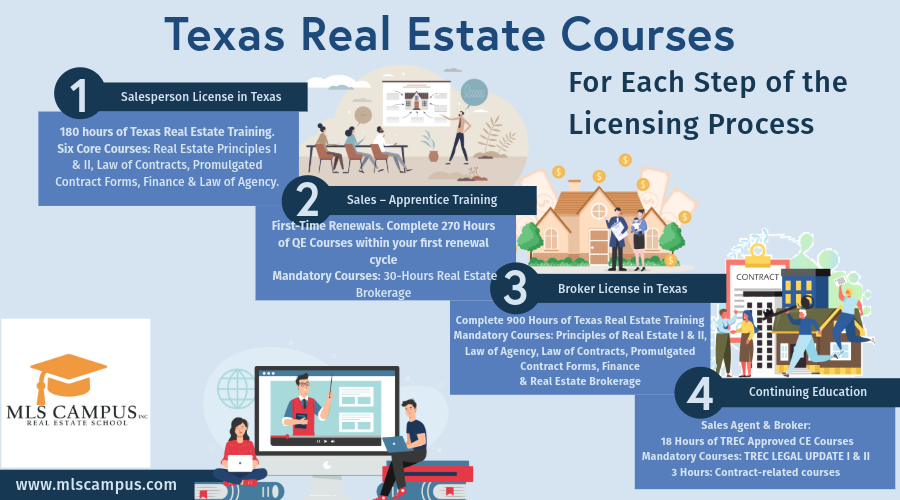
To get a salesperson license, you need 180 hours of Texas real estate training. These hours are divided into six core courses, covering topics such as Real Estate Principles, Law of Contracts, and Promulgated Contract Forms. Each module must be approved by the Texas Real Estate Commission (TREC).

The Texas real estate courses focus on the salesperson license, designed to give you the foundational knowledge you need to enter the field, including legal responsibilities, financial calculations, and client management skills.

Enroll now in our 180 hours of Texas real estate training and take the first steps in the Texas real estate licensing process.

To learn more about the licensing process, costs, and application process and get answers to frequently asked questions, follow the link to our comprehensive guide – How to Get a Texas Real Estate License.

Sales – Apprentice Training for First-Time Renewals

The Texas Real Estate Commission requires sales agents to take sales apprentice education within their renewal term. You must complete 90 hours of qualifying education within two years of obtaining your salesperson license. This equals a total of 270 hours of Texas-qualifying education.

You must complete a TREC-approved 6-hour Broker Responsibility course to renew your license if your broker has made you a supervisor. Follow the link to view our TREC- Approved Broker Responsibility Course.

IMPORTANT: As of October 1, 2023, you must take the 30-hour Real Estate Brokerage course as part of the 270 hours of QE to meet the TREC renewal requirements by your first renewal cycle.

Real Estate Broker License

A real estate broker license is for experienced salespersons who want to take their career to the next level. Brokers can run their own real estate firms, manage other agents, and represent clients in more complex transactions.

Texas Real Estate Training Requirements:

Aspiring brokers must complete 900 hours of TREC Approved Real Estate Education to obtain this license. This includes the 180 hours and 90 hours of sales apprentice education required to become a salesperson and additional real estate training focused on brokerage management, real estate law, and finance.

CE course credits also count towards the required 900 hours plus any TREC-approved academic credits through a college or university.

For a full list of approved academic course topics visit the TREC Broker License Page.

Before applying for your broker license, you must have at least four years of active experience as a licensed salesperson. This ensures you have practical, on-the-ground experience working in real estate.

A Texas real estate course for brokers focuses on leadership, team management, and the legalities of running a brokerage, helping you prepare to manage a successful real estate business.

To learn more about the broker license requirements, visit the TREC Broker License Page.

Further Texas Real Estate Training Requirements

Sales agents and brokers in Texas must take 18 hours of continuing education in Texas as part of their license renewal every two years after their first renewal cycle. The Texas Real Estate Commission must approve the courses to be accepted as education credits. Follow the link to find out more about continuing education hours and topics.

We have created a step-by-step guide on license renewal. Follow the link to learn more! Texas Real Estate License Renewal.
Texas_real_estate_courses_for_each_step_of_the_licensing_process

Why Choose an Online Real Estate School in Texas?

Attending an online real estate school in Texas offers numerous advantages over traditional classroom learning, especially for busy professionals. Here are just a few reasons why an online Texas real estate course might be the right choice for you:

  1. Flexibility and Convenience: Our online courses allow you to learn at your own pace and schedule, making balancing studies with work or family commitments easier.
  2. Cost-Effective: Our Texas online real estate courses are often more affordable than in-person classes without the added expenses of commuting or study materials.
  3. Interactive Learning Tools: Our online real estate courses for Texas include interactive tools such as quizzes, scenario-based learning exercises, and free real estate practice exams and exam prep courses to help reinforce learning and ensure you’re fully prepared for the state exam.
  4. Expert Instruction: Even though you’re learning online, you’ll still have access to our experienced instructors, who can answer questions and provide guidance as you move through the course.

By choosing MLS Campus online real estate school in Texas, you’ll have access to high-quality education that fits your life without sacrificing the comprehensive training needed to pass the Texas real estate licensing exam. We have over 15 years of experience providing thousands of students with real estate courses. Join us now and start a successful career in Texas Real Estate!

Select the Right Texas Real Estate Course Package For You

Choose the appropriate pre-licensing courses for either a salesperson or broker license based on your career goals and license status. We also offer a variety of packages. Our basic package contains all you need to prepare for your state license exam and receive your end-of-course certificate. All MLS Campus QE courses come with free real estate practice exams for Texas to help you fully prepare before taking your final exam.

We also offer packages that include Texas exam prep to help you prepare for your state licensing exam and math cram courses for those who feel they need extra exam practice.

MLS Campus also offers full audio of each course, so this may be the best option if you prefer to listen to your course while working through your program.
If you need assistance choosing the right course package, get in touch with our friendly support team now!

TREC – Important Contact Information and Links

TREC (Texas Real Estate Commission) Website

License Lookup

Contact Details:
EMAIL: [email protected]
PHONE: 512.936.3000
MAIL: Texas Real Estate Commission
P.O. Box 12188
Austin, TX 78711-2188

Do you have any questions? Reach out to our friendly support team today. Contact Us

Texas Real Estate Career Guide · 2026

What Do New Texas Agents Actually Earn in Year One? A 2026 Reality Check

Job sites promise first-year Texas agents $80,000 or more. Other data says new agents earn under $25,000. Both are technically true — and neither tells you what you will really take home. Here is the honest math on a Texas agent’s first 12 months in 2026.

~$335K

2026 Texas median home price — your commission base

100%

Commission-based — no salary, no safety net

~6 deals

To reach the roughly $62K Texas average income

3–6 mo

Typical wait for your first commission check

Read This First

Why You Will See Wildly Different First-Year Numbers

Search what a new Texas agent earns and you will get answers from $25,000 to nearly $94,000. The gap is not a mistake — it comes from how the numbers are built. Job-posting sites report averages skewed upward by experienced agents and team leads. State labor data leans lower. And almost none of it isolates a true first-year rookie.

Two more factors hide the truth. First, real estate is commission-only — an average yearly figure ignores that a rookie may earn nothing for months. Second, survivorship bias: the agents still reporting income are the ones who made it, not the majority who quit.

So treat headline salaries as the ceiling, not the expectation. The realistic first-year picture is lower, lumpier, and far more dependent on your effort and runway than any single number suggests.

The Numbers, Side by Side

Follow the Money

Where a Texas Commission Actually Comes From

Before you can judge a salary number, you have to see how one commission is built — and how little of it reaches a new agent.

The Sale Price

On a roughly $335,000 Texas home, a total commission pool is negotiated and split between the buyer and seller sides — more openly since the NAR settlement.

Your Side's Cut

Each side commonly runs about 2.5 to 3 percent. At 2.5 percent on $335,000, that is roughly $8,375 in gross commission before anyone is paid.

The Broker Split

As a new agent on a 50/50 to 70/30 split, your share of that $8,375 is roughly $4,200 to $5,900 — and that is still before costs and taxes.

The Deal Count

Reaching the ~$62K Texas average takes about six closed deals. Most rookies close far fewer in their first twelve months.

Run the Numbers

The Honest First-Year Math

Say you close four homes at the ~$335,000 median in your first year. At 2.5 percent per side, that is about $33,500 in gross commission. On a 60/40 new-agent split you keep roughly $20,100. Now subtract MLS and association dues, E&O insurance, a CRM, marketing, and gas — easily $3,000 to $6,000 — then set aside self-employment tax on what remains.

Your real take-home from four deals might land near $12,000 to $15,000. Close eight deals instead of four and the picture changes dramatically. The lesson is not that Texas pays poorly — it is that year-one income is back-loaded and built entirely on your deal count.

Sample: 4 Deals, Year One

The Deductions

4 Things That Shrink Your First-Year Take-Home

Gross commission is not income. These four deductions stand between your closings and your bank account.

01

The Broker Split

New agents commonly keep 50 to 70 percent of each commission. The rest funds your broker's training, supervision, and overhead.

02

Business & Tech Costs

MLS and association dues, E&O insurance, a CRM, a website, signage, and marketing run $3,000 to $6,000 or more in year one.

03

Self-Employment Taxes

You are an independent contractor. No employer withholds tax, and you owe self-employment tax on net earnings — reserve about 25 to 30 percent.

04

The Ramp-Up Gap

Your first closing often lands three to six months in. Texas's slower 2026 market and ~80-day sale times stretch that timeline further.

Your First Commission Starts With a License

Every dollar of that first-year income depends on getting licensed first. MLS Campus delivers Texas's full 180-hour, TREC-approved pre-license course online, at your own pace.

The Hard Truth

Why So Many New Agents Quit in Year One

Industry estimates suggest that the large majority of new agents — commonly cited near 75 to 87 percent — leave the business within their first few years. The first twelve months are the hardest, and the reason is rarely a lack of talent.

Most who wash out simply ran out of money before their business ramped. They underestimated startup costs, lacked a steady prospecting habit, or had no mentor to guide them through early deals. The math is survivable — but only if you plan for the gap between starting and earning.

Common Causes

Top Reasons Rookies Wash Out

Your Game Plan

How to Beat the Odds in Year One

The agents who survive year one tend to do these four things. None require talent — only planning and consistency.

01

Build a 6-12 Month Runway

Have savings or part-time income to cover living costs until commissions arrive. This single factor saves more careers than any other.

02

Pick a Broker Who Trains You

In year one, mentorship and deal support outweigh a high split. Choose support over the biggest percentage.

03

Prospect Every Single Day

Consistent lead generation — your sphere, open houses, follow-up — is what turns month four into your first closing.

04

Treat It Like a Business

Track every cost, set aside taxes, and reinvest early commissions into your pipeline instead of spending them.

The Upside

Texas Is Still One of the Best Places to Start

The honest first-year grind is real — but so is the opportunity. Texas pairs a ~$335,000 median price with enormous transaction volume across the Texas Triangle of Dallas-Fort Worth, Houston, San Antonio, and Austin. Add steady in-migration and no state income tax, and the agents who survive year one are positioned to scale income fast.

Top Texas producers close twenty or more deals a year and clear well into six figures. The first twelve months are a filter, not a forecast. Get through them with a plan, and the ceiling is genuinely high.

Key Takeaway

Why Texas Rewards Persistence

FAQ

New Texas Agent Income: Frequently Asked Questions

Honestly, far less than job-site averages suggest. Many rookies net well under $25,000 in their first twelve months once the broker split, business costs, and the slow ramp are factored in. A motivated agent who closes six or more deals can reach or beat the roughly $62,000 state average.

No. Almost all Texas agents are independent contractors paid only by commission. There is no base pay, no benefits, and no tax withholding — you earn when a deal closes.

Commonly three to six months. You need time to build a pipeline, and a Texas transaction in 2026 takes roughly 80 days from contract to close, on top of the time it takes to find the client.

At the ~$335,000 median and a typical split, about six closed deals gets you near the state average income. Your exact number depends on your price point, commission split, and business costs.

Beyond licensing, expect MLS and association dues, E&O insurance, a CRM, and marketing — commonly $3,000 to $6,000 or more — plus self-employment taxes on your net earnings.

Yes, for the right person. Texas has high transaction volume, strong in-migration, and no state income tax. The first year is a test of runway and consistency, but agents who get through it can scale their income quickly.

Start Smart

Go In With Eyes Open — and a Plan

A realistic view of year one is your biggest advantage. Get licensed with the MLS Campus TREC-approved 180-hour course, line up your runway, and build the business that outlasts the agents who quit.

Texas Real Estate Career Guide · 2026

How to Find a Sponsoring Broker in Texas: 7 Questions to Ask Before You Sign in 2026

In Texas, your real estate license stays inactive — and you cannot earn a single commission — until an active broker agrees to sponsor you. The broker you choose shapes your income, your training, and your entire first year. Here is exactly how to find the right one.

Required

Active sponsorship to work as a Texas agent

60/40–70/30

Typical commission splits for brand-new agents

Inactive

Your license status until a broker sponsors you

100%

Of your commissions must be paid through your broker

Why It Matters

Your Sponsoring Broker Is the Most Important Decision You Will Make

Passing the Texas exam is a milestone — but it does not make you a working agent. Under the Texas Real Estate License Act (TRELA), a sales agent cannot legally practice or be paid until an active Texas broker sponsors them. Your broker is the legal umbrella you operate under.

That relationship does more than activate your license. Your broker is responsible for supervising your real estate activities, every commission and referral fee you earn flows through them, and the training and culture they provide will heavily influence whether your first year is profitable or painful.

Because you can change brokers at any time, this is not a life sentence — but switching mid-deal is disruptive and your license goes inactive in any gap. Getting the choice right the first time is worth a few focused conversations.

Texas Sponsorship At-a-Glance

The Broker Relationship

What a Texas Sponsoring Broker Actually Does

Before you compare offers, understand the four roles every sponsoring broker plays in your career.

Activates Your License

Your license sits inactive until you file a Sales Agent Sponsorship Request and a broker accepts. Sponsorship is what lets you legally practice and earn.

Supervises Your Work

Under TRELA, your broker is responsible for your real estate activities and must keep written policies for supervising sponsored agents.

Pays Your Commissions

Texas law requires every dollar you earn — including referral fees — to be paid through your sponsoring broker, never directly by a client.

Trains & Mentors You

The strongest brokers provide onboarding, contract guidance, and a mentor for your first deals — where new agents grow the fastest.

Your Search

Where to Find a Sponsoring Broker in Texas

You have more options than the big sign on the corner. From national franchises with structured training to nimble local independents and fully virtual cloud brokerages, Texas offers a brokerage for every working style. Many new agents also find their first sponsor through their pre-license school network or a fellow graduate.

Whatever the source, treat it like a two-way interview. The brokerage is evaluating you, but you are also deciding where your career will live for the next year. Line up conversations with at least three brokerages so you can compare splits, coaching, and culture side by side.

Smart Places to Start

The 7 Questions · Part 1

Questions 1–4: Your Money and Your Growth

The first four questions protect your income. Ask every brokerage the same set so you can compare apples to apples.

01

What is the commission split — and how does it change?

Ask for the exact split, whether it is graduated as you produce, and if there is an annual cap after which you keep 100%.

02

What are ALL the fees, in writing?

Desk fees, technology fees, E&O insurance, transaction fees, and franchise royalties can quietly erase a generous split.

03

Do you provide leads, or do I generate my own?

Some brokerages supply leads; most expect you to build your own pipeline. Know exactly which before you sign.

04

What does training and onboarding actually look like?

Ask for specifics: a written program, live coaching, deal reviews, and how long mentorship lasts past month one.

Not Licensed Yet? Start With Your 180-Hour Texas Course

Before any broker will sponsor you, you need a TREC-approved sales agent license. MLS Campus delivers the full 180 hours online, at your own pace, with exam prep built in.

Read the Fine Print

Decoding Commission Splits, Caps, and Fees

A headline split is meaningless without the full fee picture. New Texas agents commonly start near 50/50 to 70/30, with many brokerages raising the split as you produce and some offering a cap after which you keep everything. But a flashy 90/10 split paired with heavy desk, technology, and transaction fees can net you less than a modest split with strong support.

Model your real take-home pay. Estimate your first-year deal count and average commission, then subtract every recurring and per-transaction fee. In year one, the training and mentorship behind a lower split usually pay for themselves many times over.

Checklist

Fees to Ask About Up Front

The 7 Questions · Part 2

Questions 5–7: Support and Your Exit

The final three questions protect your day-to-day support and your freedom to move on if the fit is wrong.

05

Who actually supervises me day to day?

In Texas a broker may delegate supervision to a manager. Find out who you will truly turn to with contract and compliance questions.

06

What technology, marketing, and tools are included?

CRM, websites, transaction management, and lead tools vary widely. Confirm what is included versus what costs extra.

07

What happens if I want to leave?

Ask how license transfer works, who keeps pending commissions, and whether any non-compete or claw-back terms apply.

Before You Sign

Get every promise in writing, compare at least three brokerages, and never decide on the commission split alone.

Proceed With Caution

Red Flags to Watch For Before You Sign

Texas is one of the most active real estate markets in the country, and recruiting agents know how appealing that is to a new licensee. That energy is exciting, but it can also mask a poor fit. A broker who pressures you to sign on the spot, gives vague answers about fees, or cannot describe a concrete training plan is telling you something important.

Trust the pattern, not the pitch. The brokerage that answers every one of your seven questions clearly — and puts the key terms in writing — is the one most likely to support you when a deal gets complicated.

Key Takeaway

Watch For These

FAQ

Texas Sponsoring Broker: Frequently Asked Questions

Yes. A Texas sales agent license is inactive until an active broker sponsors you. You cannot legally perform real estate activities or be paid a commission without sponsorship.

Once a broker agrees, you submit a Sales Agent Sponsorship Request through TREC online licensing system. The broker confirms it electronically and your license becomes active. TREC does not charge a fee for this step.

Yes, at any time. You file a new sponsorship request when joining a new broker. Your license goes inactive during any gap, so it is best to line up your next sponsor before leaving your current one.

New agents commonly start around 50/50 to 70/30. Many brokerages raise your split as you produce, and some offer a cap after which you keep 100%. Always weigh the split against the fees and training you receive.

In some cases, Texas allows compensation to a licensed business entity, but all payments must still flow through your sponsoring broker. Confirm the structure with your broker and review the current TREC rules.

Not necessarily. National brands offer recognition and structured training, while local and boutique firms often offer closer mentorship and market expertise. The best fit depends on how you learn and the support you need in year one.

Start Today

Get Licensed, Then Choose Your Broker With Confidence

Your sponsoring broker decision starts with one thing: an active Texas license. Complete your TREC-approved 180-hour pre-license course with MLS Campus and walk into broker interviews ready to ask all seven questions — and negotiate.