Texas Real Estate Broker National and State Exam Preps Packages
- ✔
Proven Success: Flexibility & Convenience students can learn anytime, anywhere.
- ✔
Career-Ready Curriculum: Courses are regularly updated with current laws, regulations, and market trends.
- ✔
Interactive Learning: Quizzes, video lessons, case studies, and virtual simulations make learning engaging and effective.
- ✔
Expert Guidance: Learn from licensed, experienced real estate professionals who understand the local and national market.
Starting at $59
Prepare for Exam Day with Confidence
Completing your qualifying broker education is a massive milestone, but the ultimate challenge remains: passing the rigorous Texas real estate broker exam. While your core coursework provides the foundation, mastering the separate National and State portions requires targeted practice to train your brain for complex scenario-based questions.
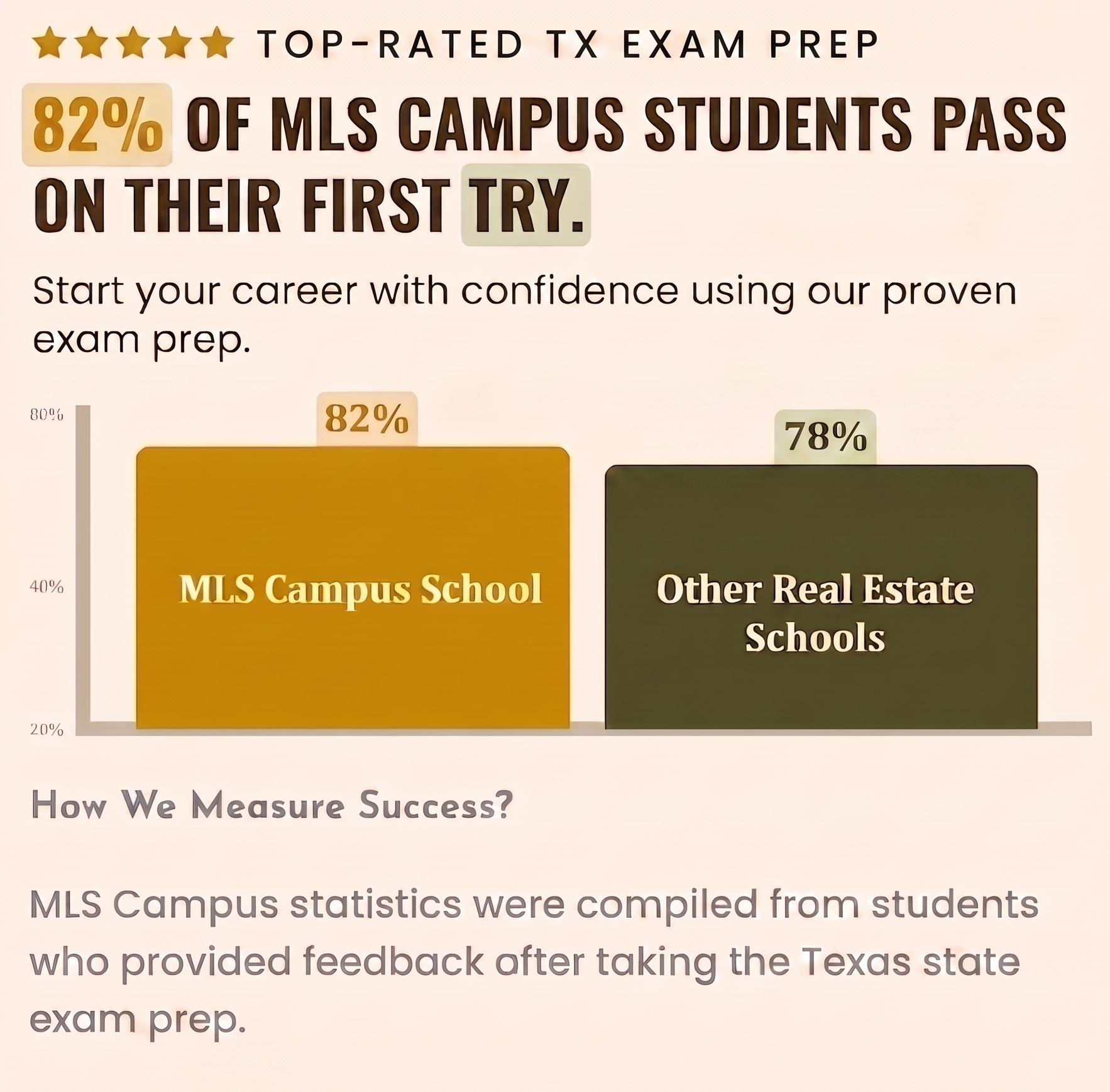
MLS Campus offers comprehensive Broker Exam Prep tools designed specifically to help you pass on your first attempt. Sharpen your knowledge with Texas-specific legal questions, master the national math and valuation concepts, identify your weak spots, and get comfortable with the actual layout of the Pearson VUE broker exam. With this specialized preparation, you will walk into test day confident, focused, and ready to step into your new role as a licensed Texas Real Estate Broker.
Compare Texas Broker Exam Prep Packages
Foundational Review and Reference
- 6 Months Unlimited Access
Strengthening Math Understanding
- 6 Months Unlimited Access
Structured Exam Preparation (Includes e-book and math cram)
- 6 Months Unlimited Access
Deep Understanding, Maximum Confidence & Ultimate Exam Readiness
- 1 Year Unlimited Access
How Hard Is the Texas Real Estate Broker Exam?
| Exam | Texas Real Estate Broker, administered by Pearson VUE for TREC |
|---|---|
| Questions | 145 items: 85 on the national portion and 60 on the Texas state portion. 130 of these are scored (80 national + 50 state); the rest are unscored pretest items |
| Time allowed | 240 minutes (4 hours) covering both portions |
| Passing score | 60 of 80 national and 38 of 50 state. TREC scores the exam as a raw count of correct answers |
| Examination fee | $39 per attempt, paid to Pearson VUE when you book |
| Regulator | Texas Real Estate Commission (TREC) |
Texas Broker Exam Prep – Frequently Asked Questions
What does the Texas broker exam prep include?
How much does it cost?
Will it help me pass?
Do I still need the 270-hour broker education?
Is it online?
What score do I need to pass the Texas real estate broker exam?
How many questions are on the Texas broker exam?
How long is the Texas broker exam?
How much does the Texas broker exam cost?
When will I get my Texas broker exam results?
Texas Broker State & National Exam Prep Master
Welcome to MLS Campus – Your Ultimate Resource for Texas Broker Exam Success!
Welcome, future real estate professionals! Get ready to conquer the Texas real estate licensing exam with the MLS Campus Texas Broker State & National Exam Prep Master and Math Cram. This all-in-one tool is designed to help you confidently pass both the state and national portions of the Texas Broker Exam.
Having completed (or nearly completed) your 270-hour Texas Broker Pre-License Course, you're already on the right track. Now, it's time for the final step—taking the Texas state exam. We understand that this may feel overwhelming, but don't worry, we’ve got you covered every step of the way.
Why Choose MLS Campus?
With over 20 years of experience in real estate education and curriculum development, MLS Campus knows exactly what it takes to pass the exam. Here's why you can count on us for top-notch exam preparation:
Texas-Focused, Exam-Aligned Content
Our prep system is designed specifically to meet the Texas licensing exam requirements, with a strong focus on both the national and Texas-specific content. It includes:
- Focused Reviews: Concise key points to help with fast memorization and quick recall during the exam.
- Practice Questions: A mix of national topics and Texas-specific laws and regulations, including everything you need to know from the Texas Real Estate Commission (TREC).
- Exact Exam Alignment: Content that mirrors the structure and topic sequence of the official Texas exam syllabus, ensuring you're fully prepared.
MLS Campus Exam Prep Master Features
An engaging online study platform crafted to provide you with the essential knowledge and confidence to pass the Texas Broker State and National exam, propelling your real estate career forward.
- 20 Exam-Style Practice Exams: Comprehensive practice exams that simulate the real test format, helping you get familiar with the types of questions you will encounter.
- Extensive Content Coverage: Includes key topics such as Texas real estate laws, agency relationships, contracts, property ownership, and more, fully aligned with the exam syllabus.
- Interactive Learning Experience: Engaging quizzes, detailed explanations, and instant feedback to reinforce understanding and improve retention.
- Accessible Anywhere: Study on any device, at any time, with our mobile-friendly platform, allowing you to prep at your convenience.
- Instructor Assistance: Get support from licensed real estate instructors who are available to help clarify concepts and guide you through the material.
Practice, Review, and Mastery
After completing each practice test, you’ll receive an answer key with in-depth explanations to clarify concepts and correct any misunderstandings. To get the most out of your prep:
- Thoroughly review the key points.
- Take all practice tests to gauge your readiness.
- Reflect on incorrect answers and revisit weak areas.
- Keep repeating until you consistently score 80% or higher on practice tests.
Simulate Exam Conditions for Success
To simulate actual exam conditions, time your practice test sessions and work on your pacing. When you consistently score well, you’ll know it’s time to schedule your state exam with confidence.
Is the Texas Real Estate Exam Multiple-Choice?
Yes, the Texas real estate license exam consists of multiple-choice questions that assess your understanding of real estate practices, laws, and regulations specific to Texas.
What to Bring on the Day of Your Exam
To ensure you have a smooth check-in process on the day of your exam, arrive at the testing center at least 30 minutes early. Make sure you bring the following items with you:
- Valid Identification
You’ll need two forms of identification (IDs). Both must be non-expired and include your signature.- Primary ID: This must be a government-issued photo ID with your signature. Examples include:
- Driver’s license (U.S. or state-issued)
- Passport or passport card
- Military ID
- Alien Registration Card
- Secondary ID: This should also have your signature, but does not need to include a photo. Examples include:
- Social Security card
- Credit card
- Primary ID: This must be a government-issued photo ID with your signature. Examples include:
- Calculator
For the math portion of the exam, bring a small, basic, non-programmable calculator. The testing center does not provide calculators, so it is essential to bring your own. Ensure that it complies with Pearson VUE’s testing guidelines. - No Personal Items
Keep in mind that the testing center typically does not allow bags, personal items, or electronic devices like cell phones, smartwatches, or tablets inside the exam room. You’ll need to leave these items in a secure location before entering the testing area.
What to Expect on the Texas Real Estate Exam
The Texas Real Estate exam is divided into two sections: a national portion that covers general real estate knowledge and a state-specific portion that tests you on Texas real estate laws and regulations. Both sections must be passed to receive your license.
- National Section Breakdown
The national portion consists of 85 questions covering topics such as property ownership, contracts, financing, and more. This section is allotted 150 minutes to complete. - State Section Breakdown
The Texas-specific portion of the exam consists of 40 questions that focus on local laws, regulations, and practices. You’ll have 90 minutes to complete this section.
For more details on the Texas Salesperson Exam and the Texas Broker Exam, including test locations, policies, and score reporting, please visit:
https://www.trec.texas.gov/
Texas Broker State & National Exam Math Cram
An interactive online study experience that comprehensively explains real estate math and essential formulas. It features a series of real estate math cram exams and offers guided preparation to help you succeed on the Texas Broker State and National licensing exams.
MLS Campus Math Cram Features
- 10 Practice Exams: Designed to help you master the math portion of the Texas Broker State and National licensing exams.
- Step-by-Step Explanations: Detailed solutions to enhance understanding of real estate math concepts.
- Unlimited Access: Study at your own pace, with no time constraints.
- Mobile-Friendly: Access the course on any device, anytime.
- Instructor Support: Reach out to licensed instructors for assistance when needed.
Real Estate Math Mastery
Real estate math is a crucial component of the licensing exams. Our Math Cram course provides:
- Step-by-Step Explanations: Detailed solutions to enhance understanding of real estate math concepts.
- Practice Exams: Designed to help you master the math portion of the licensing exams
- Chapter Reviews and Quizzes: Designed to reinforce key concepts and track your progress.
- Guided Preparation: Structured lessons to build confidence and proficiency.
Does the Texas Real Estate Exam Have Math?
Yes, the Texas Real Estate Exam includes math-related questions. These questions assess your understanding of basic mathematical concepts essential for real estate transactions, such as calculating commissions, prorations, and property taxes. While the math questions are not overly complex, they are integral to the exam and real estate practice. It's advisable to review these topics thoroughly during your preparation.
Do You Have to Be Good at Math to Be a Texas Real Estate Broker?
A solid grasp of basic math is essential for a career as a real estate broker in Texas. Brokers frequently use math to calculate their own earnings and the commissions for their agents based on sales prices and commission rates, prorate expenses like property taxes, insurance, and utilities between buyers and sellers, and analyze various financial aspects of transactions, such as loan terms, closing costs, and investment potential. While advanced math skills are not required, proficiency in basic arithmetic and understanding real estate-related calculations is crucial for success in the field. Brokers need to be comfortable with these math concepts to manage transactions effectively, ensure accuracy in paperwork, and guide clients and agents with confidence.
How Does a Texas Real Estate Broker Use Math?
In Texas, real estate brokers also rely on fundamental math skills to manage various aspects of their profession. These skills are essential for tasks such as:
- Calculating Commissions: Brokers determine their own earnings, as well as the commissions for their agents, based on sales prices and commission rates.
- Prorating Expenses: Brokers calculate the allocation of costs like property taxes, insurance, and utilities between buyers and sellers, as well as between agents and clients.
- Estimating Closing Costs: Brokers provide clients with accurate estimates of the fees associated with property transactions, including loan origination fees, title insurance, and escrow costs.
- Analyzing Loan Terms: Brokers evaluate interest rates, monthly payments, and amortization schedules to assist clients in making informed decisions about financing options.
These mathematical applications are integral to managing transactions and overseeing agents in Texas. Proficiency in these areas ensures accuracy, supports smooth operations, and builds trust with clients and agents. Brokers need to have a strong understanding of these concepts to maintain professionalism and successfully guide real estate deals.
The Importance of Math Skills for Texas Real Estate Brokers
For Texas brokers, a solid understanding of real estate math is essential. It helps them:
- Ensure Precision: Accurately calculate commissions, taxes, and other financial elements involved in transactions.
- Build Client Confidence: Establish trust by providing reliable financial analysis and professional guidance.
- Streamline Transactions: Prevent costly mistakes that could cause delays or disputes during property deals.
With strong math skills, brokers can navigate complex transactions with ease and professionalism, ensuring smooth operations and successful outcomes for both clients and agents.
FREE Texas Real Estate Math Cheat Sheet PDF
A key part of mastering real estate math is understanding the specific terminology related to the formulas. The Texas Real Estate Math Cheat Sheet focuses on key math terms and definitions. By grasping these terms, you'll be one step closer to passing your exam on the first attempt! You’ll also have the tools to solve any real estate math questions with confidence. We provide you with a free Texas Real Estate Math Cheat Sheet PDF, which you can print to help you memorize the essential math terms and formulas you need to succeed!
Texas Real Estate Broker State and National Exam Prep eBook
Your Complete Guide to the Texas Real Estate Broker State and National Exam Prep 2025 Edition!
Embark on your journey to becoming a licensed Texas Real Estate Broker with the ultimate preparation guide for the Texas Real Estate Broker State and National Exam. Whether you're new to real estate or revisiting key concepts, the Texas Real Estate Broker State and National Exam Prep 2025 Edition is designed to walk you through everything you need to know to pass your exam and advance your career as a real estate professional in Texas.
Why This Guide Is the Key to Your Success:
This comprehensive, up-to-date exam prep guide is meticulously tailored to meet the Texas Real Estate Commission’s (TREC) requirements, ensuring that you cover every topic relevant to the real estate broker exam. Packed with practice questions, quizzes, and in-depth review sections, this guide provides a complete roadmap to prepare thoroughly for both the state-specific and national portions of the exam. It’s all you need to succeed!
Comprehensive Breakdown of What’s Inside:
This guide offers a step-by-step review of the essential material, designed to help you master the knowledge required to pass the exam with confidence. Here's a glimpse of what you’ll find:
- Real Estate Glossary: A detailed compilation of the most important real estate terms, key to understanding the legal language and concepts required for both portions of the exam.
- National Portion Review: Covering the principles of real estate, law of agency, property management, real estate appraisal, financing, and much more. This section ensures you're prepared for the national portion of the exam.
- Texas State Portion Review: Focused on Texas-specific laws, including the Texas Real Estate License Act, contract law, brokerage operations, law of agency, and promulgated contract forms—all essential for passing the state exam.
- Real Estate Math Review: A thorough breakdown of the key math concepts that are critical to understanding financial calculations in real estate transactions.
- Practice Exams & Quizzes: Five full-length practice exams, along with individual quizzes for each section. Detailed answers and explanations help reinforce what you’ve learned.
- Step-by-Step Study Plan: Proven methods to guide your study process, from beginning to the final exam. This approach ensures you stay focused and well-prepared.
Part One: Texas Real Estate State and National Broker Reviews
This part contains reviews and quizzes covering both the National and Texas portions.
National Portion Review:
- Section 1: Principles of Real Estate I
- Topics include Real Estate Business, Home Ownership, Real Property, Law of Agency, Fair Housing, Ethics, Interest in Real Estate, and Ownership Rights and Limitations.
- Section 2: Principles of Real Estate II
- Topics include Real Estate Appraisal, Real Estate Financing, Land Use and Environmental Issues, Real Estate Investments, Property Management, and Managing Risk.
- Section 3: Real Estate Finance
- Topics include Money & the Monetary System, Government Influence on Real Estate, Financing Real Estate, Loan Structures, Interest Rates, Loan Types (FHA, VA, Conventional), Government Loans, and Defaults and Foreclosures.
Texas State Portion Review:
- Section 1: Contract Law
- Focuses on Texas Contract Law, Texas Real Estate License Act, Legal Descriptions, Real Estate Law, Introduction to Contracts, Sales Contracts, Estates, Transfers, and Titles, Contingencies, and Transaction Closing Procedures.
- Section 2: Promulgated Contract Forms
- Leases, Covenants and Commitments, Closing and Possession, Real Estate Matters, Other Contract Forms.
- Section 3: Law of Agency
- Topics include Duties to Third Parties, Seller Agency, Listing Agreements, Texas Buyer Representation Procedures, Intermediary Brokerage, Agency Relationships, and Employment Issues.
- Section 4: Texas Real Estate Brokerage
- Topics include Starting a Brokerage, Ethical & Legal Business Practices, Market & Competition Analysis, Broker/Sales Agent Roles, Marketing Best Practices, and Recruiting and Hiring.
- Section 5: Real Estate Marketing
- Focus on Marketing Concepts, Prospecting, Pricing Services, Successful Marketing Strategies, and State and Federal Laws in marketing.
- Section 6: Residential Property Management
- Focuses on Property Management Overview, Tenant Relations, Marketing, Single-Family Residential Leases, Commercial Leasing, Maintenance, and Safety and Risk Management.
Part Two: Real Estate Math Review
- Includes topics like Real Estate Valuation, Mortgage Calculations, PITI, Financial Calculations for Real Estate Operations, and more.
- Example problems and practice for key calculations required for the exam.
Part Three: Practice Exams and Answers
- Five Practice Exams: Comprehensive exams with answer explanations that mimic the format and difficulty level of the actual Texas Real Estate Broker Exam.
- Detailed Answer Explanations: Helps clarify any misunderstandings and reinforces knowledge.
Appendix: Useful Websites & Resources
- Resources for Texas Real Estate Students: Links to helpful websites for studying and preparing for the Texas Real Estate License Exam.
Special Focus Areas:
- Texas Real Estate License Act (TRELA): The comprehensive framework governing real estate professionals in Texas.
- Promulgated Contract Forms: Official Texas forms for various real estate transactions.
- Agency Law: Focus on the duties of brokers and agents, including disclosures and legal requirements.
- Brokerage Operations: A review of how to operate a real estate brokerage, including legal practices and ethical standards.
- Risk Management and Legal Issues: Covers various legal matters that a real estate broker must be aware of to minimize risk and liability.
This guide is structured to provide a thorough review of all necessary concepts for both the national and state portions of the exam, with a focus on Texas-specific laws. It includes study strategies, key point reviews, detailed math explanations, and practice exams to ensure you're well-prepared.
Download the Texas Real Estate Broker State and National Exam Prep 2025 Edition today and begin your path to success as a licensed real estate agent!
1 Day Limited Money Back Guarantee Policy
If you decide you’re not 100% satisfied within the First Day of your initial purchase, simply contact us by email and request a cancellation and full refund. You will receive a full refund of your purchase price.
Course Duration
The course is active for six months from the date of purchase. We offer the 7th month for free if needed. If your course has been active for 7 months or more, you can purchase one-month extensions. It is possible to have the course extended up to one year by purchasing monthly extensions online.
Customer Support: Call us at (877) 331-6235 or Contact us by Email
If we can assist you with Technical Support, General License Inquiries or Questions about Course Material please contact us.
Questions about course material: An Instructor is available Monday through Friday a week from 9 am to 7 pm (EST)
Technical Support or any other questions: Our office staff are available Monday through Friday a week from 9 am to 7 pm (EST)
We do our best to reply promptly to emails on Weekends
*Except for Major Holidays
What Are Your Real Estate Broker Exam Prep Options in Texas?
Looking for a list of real estate broker exam prep options in Texas? MLS Campus offers several, all 100% online and self-paced, covering both the national and Texas state portions of the broker exam:
- Texas Broker Exam Prep Master — the complete option: full topic review plus practice questions and simulated broker exams.
- Texas Broker Exam Prep eBook — a downloadable study guide for the broker exam.
- Texas Broker Premium Exam Prep — everything in Master, plus extra practice exams and priority support.
- Texas Broker Math Cram — a focused crash course on the real estate math the broker exam tests.
Compare the broker packages and pricing on this page and choose the option that fits how you study.