2026 Licensing Trend
Upgrading Your License: The 2026 Push for a 4-Year Broker Requirement
States are raising the bar. Texas doubled its broker experience points. The national average is creeping toward four years. Here is what every serious real estate agent needs to plan for right now.
The Bar Is Rising for Real Estate Brokers in 2026
For years, the path from salesperson to broker was straightforward: accumulate the minimum required experience, complete your coursework, pass the broker exam. In most states, that experience threshold sat comfortably at two years. That era is shifting. In 2026, a clear trend is emerging across state licensing boards, legislative chambers, and industry advisory committees: the push for longer, more rigorous broker experience requirements — with four years increasingly becoming the new benchmark.
Texas led the charge with landmark changes under Senate Bill 1968, effectively doubling the experience bar for broker applicants starting January 1, 2026. Several other states are actively reviewing their thresholds. The driving forces behind this shift are clear: the post-NAR settlement landscape demands more sophisticated broker oversight, public accountability is increasing, and the industry recognizes that a two-year window is simply not enough time to build the transaction depth and supervisory judgment a principal broker needs.
If you are a salesperson with your eye on a broker license, this article is your essential 2026 planning guide. We break down what has changed, why it is happening, how requirements compare state by state, and exactly what you need to do now to position yourself for a successful upgrade.
Texas Sets the Standard: How SB 1968 Changed the Game
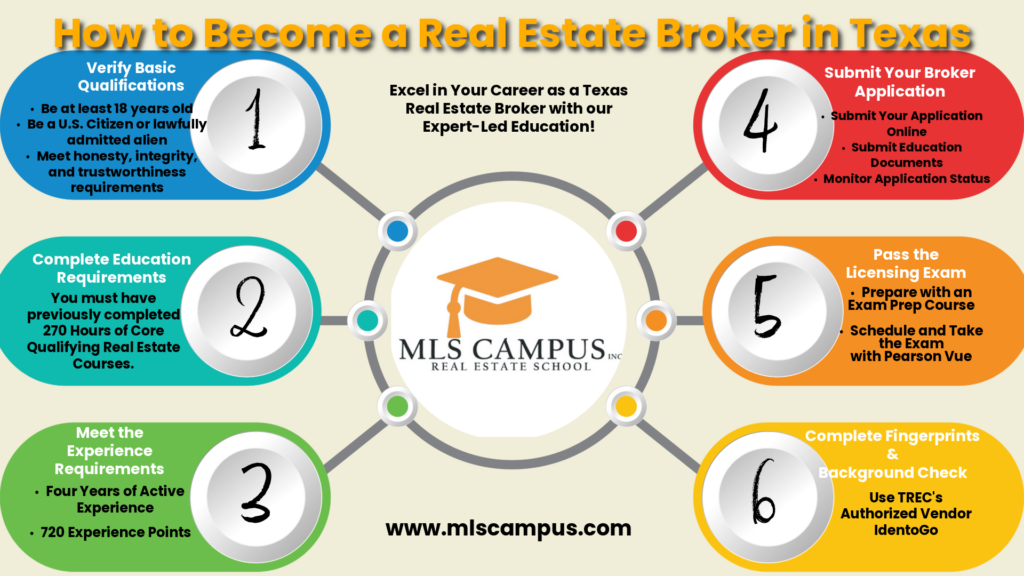
The most concrete and immediate example of the 4-year push is Texas. Prior to January 1, 2026, a broker applicant in Texas needed to accumulate 360 experience points over four years of active salesperson history within the preceding five years. That system, introduced in 2022, already required the four-year window — but the minimum points threshold was relatively accessible.
Under the updated rules driven by the Texas Real Estate Commission’s Broker Responsibility Advisory Committee (BRAC) and Senate Bill 1968, the minimum experience point requirement doubled from 360 to 720 points. This means aspiring brokers now need significantly more hands-on transaction activity — not just more years, but more volume and depth.
The 2026 changes also cap bachelor’s degree substitution at 300 hours (down from 630 hours toward education requirements), placing greater emphasis on practical field experience over academic credentials alone. Every broker applicant must now complete the Broker Responsibility Course before receiving their license — regardless of whether they plan to supervise agents.
Why Is the Industry Pushing for Longer Experience Requirements?
The 4-year movement is not arbitrary. Several converging forces are driving regulators, advisory committees, and industry groups toward stricter broker qualification standards.
Post-NAR Settlement Complexity
The 2024 NAR settlement transformed commission structures and disclosure requirements. Brokers now carry greater legal and compliance responsibilities around buyer-agent agreements — responsibilities that demand deep, seasoned experience to manage properly.
Supervisory Accountability Standards
Brokers are legally liable for the actions of agents they supervise. Recent disciplinary cases, including license revocations for failure to supervise, have pressured regulators to ensure brokers have genuine leadership experience before taking on agents.
Market Complexity Has Grown
Interest rate volatility, affordability crises, new construction mandates, and shifting buyer behavior have made real estate transactions far more complex than a decade ago. Two years is often not enough to see agents through a full market cycle.
Public Transparency Push
New laws like New York's RPL 441-c amendment making revocation histories permanently searchable signal a broader push for professional accountability. Licensing bodies are raising entry floors to reduce future disciplinary cases.
Leadership Pipeline Quality
Industry research consistently shows that brokerages with experienced, well-qualified principal brokers produce better-trained agents, fewer consumer complaints, and higher retention rates. The 4-year push is partly a talent pipeline strategy.
Brokerage Business Demands
Running a brokerage now requires managing technology systems, trust accounts, compliance documentation, E&O insurance coordination, and agent training programs. With over 360,000 brokerage firms in the US, the operational bar has never been higher.
State-by-State Broker Experience Requirements: 2026 Snapshot
How the major real estate markets compare on broker experience thresholds right now
| State | nExperience Required | nEducation Hours | nNotable 2026 Change | n
|---|---|---|---|
| Texas | 4 years / 720 pts | 900 hours | Points doubled to 720 |
| California | 2 years (last 5) | 8 college courses | Fair housing module added |
| New York | 2 years (active) | 120 hours | 3-yr revocation rule now law |
| Florida | 2 years (24 months) | 72 hours | Under legislative review |
| Colorado | 2 years (active broker) | 168 hours | Jan 2026 rule update active |
| Virginia | 3 years (full-time) | 180 hours | Supervision duties under review |
*Requirements verified against official state licensing authority sources. Always confirm current requirements directly with your state’s licensing board before applying.
“Becoming a real estate broker requires more than logging time. Brokers must be business managers, compliance experts, mentors, and market strategists all at once. The 2026 landscape demands nothing less.”
— Industry Analysis, Luxury Presence Real Estate Research, 2026
What the 4-Year Push Means If You Are Planning to Upgrade
Whether your target state currently sits at two years or has already moved to four, the trajectory is clear: broker licensing is becoming a more deliberate, experience-intensive credential. Here is what you need to be thinking about right now.
📅
Start Tracking Your Experience Nown
Whether your state uses a years-based or points-based system, begin documenting every qualifying transaction today. Closed sales, leases, referrals, and property management deals all contribute. Waiting until you feel ‘ready’ to upgrade often means discovering you have documentation gaps at the worst possible moment.
📚
Enroll in Broker Pre-Licensing Early
In most states, you can begin your broker pre-licensing coursework before you have completed the full experience requirement. Use your salesperson years to chip away at the education component simultaneously. In Texas, that means starting on your 900 hours well before you hit 720 experience points.
⚖️
Know Whether a Degree Can Substitute
California allows a 4-year degree with a real estate major or minor to waive the experience requirement entirely. Texas previously allowed a bachelor’s degree to satisfy 630 of 900 education hours — but in 2026, that substitution is now capped at 300 hours. Know your state’s exact rules before relying on academic credentials to fast-track your application.
📊
Choose Your Transactions Strategically
In point-based states like Texas, not all transactions are equal. A closed residential purchase or sale earns 30 points, while a lease earns only 5. If you are targeting a broker license within the next two to three years, actively pursuing closed sales over lease transactions will accelerate your qualification timeline significantly.
📋
Prepare for the Broker Responsibility Course
As of January 2026, all Texas broker applicants must complete the Broker Responsibility Course before receiving their license — not just those who supervise agents. This is the direction the industry is heading broadly. Understanding supervision duties, trust accounts, risk management, and compliance processes is increasingly expected before you hang your broker’s shingle.
The Broker Exam: More Demanding Than Ever
The broker licensing exam has always been more rigorous than the salesperson exam. It tests advanced knowledge of brokerage management, supervision, contract law, risk, and finance. In 2026, with higher experience requirements setting the table, exam content is also evolving to reflect the post-settlement landscape.
Key exam topic areas you need to master for the broker upgrade include:
- ✓Trust account management & escrow compliance
- ✓Agent supervision duties and liability exposure
- ✓Buyer representation agreement requirements
- ✓Commission disclosure rules post-NAR settlement
- ✓Fair housing, antitrust & professional ethics
- ✓Brokerage office setup, E&O insurance, record keeping
5 Actions to Take Right Now If You Plan to Upgrade
Check Your State’s Current Threshold
Log in to your state licensing board website today and verify the current experience requirement. Requirements are actively changing — what was true 12 months ago may not be true today.
Document Every Transaction
Get your sponsoring broker to certify your transaction history now, not right before you apply. In Texas, Supplement A must be broker-certified and TREC-reviewed before points are counted.
Begin Broker Coursework Now
Most states allow you to start broker education before completing the experience requirement. Use this time overlap strategically — don’t wait until year four to open your first coursebook.
Maximize High-Value Transactions
In point-based systems, closed sales outweigh leases by 6-to-1. Build your pipeline around purchase transactions to accelerate your qualification timeline and deepen your market expertise simultaneously.
Study Supervision & Management Now
The broker exam increasingly tests brokerage operations and agent supervision. Start immersing yourself in these topics during your salesperson years. Great brokers are built over time, not assembled at the finish line.
Frequently Asked Questions
Everything agents are asking about the 2026 broker experience changes
Does every state now require 4 years of experience for a broker license?
Can I start my broker pre-licensing courses before I have completed the experience requirement?
In Texas, how exactly do the 720 experience points work?
Does a college degree help with broker licensing requirements?
What topics does the broker exam cover that the salesperson exam does not?
How does the push for longer experience requirements affect agents planning to open their own brokerage?
Start Your Upgrade Today
Your Broker License Is Your Next Level. Start Building for It Now.
MLS Campus offers state-approved broker pre-licensing courses in Texas, New York, Florida, and more. Begin your coursework now and be fully positioned when your experience threshold is met.